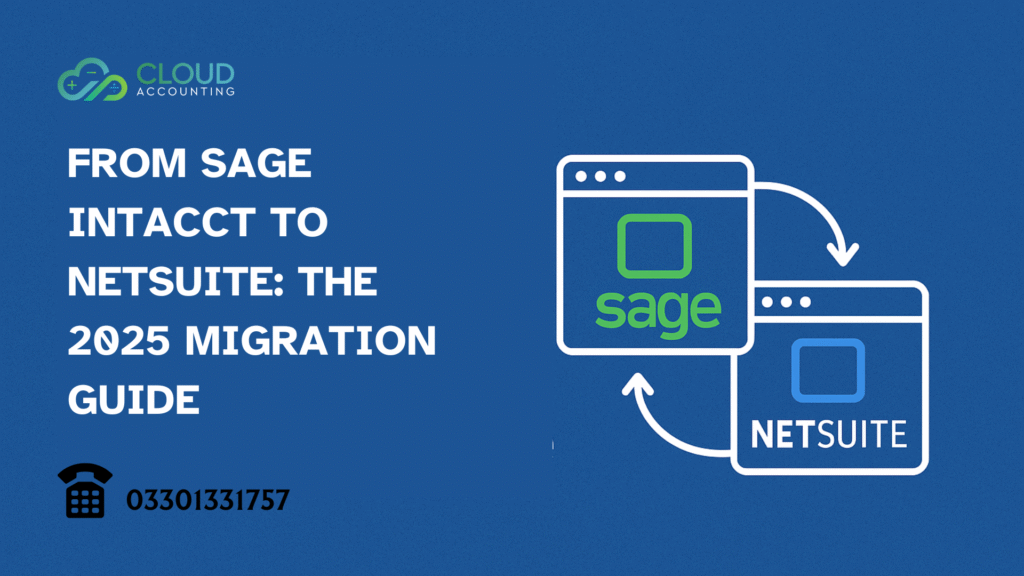
Switching accounting platforms is never just about moving numbers from one system to another. For many finance teams, it’s about upgrading to a solution that can handle today’s demands while preparing for tomorrow’s growth. That’s why more businesses are looking closely at a Sage Intacct to NetSuite migration in 2025.
Sage Intacct is well-regarded for its strong financial controls and multi-dimensional reporting, but as companies expand into multiple entities, currencies, and international markets, the platform often shows its limits. NetSuite, by contrast, is a full ERP with built-in scalability, advanced reporting, and integrations that extend far beyond core accounting. The choice to migrate is rarely made lightly — but for many, it’s the right move at the right time.
This guide explores the key differences between the two systems, why businesses decide to make the switch, and what’s involved in the actual migration. We’ll also highlight how Cloud Accounting supports every step, ensuring the process is accurate, compliant, and tailored to your business.
Whether you’re a CFO weighing costs and scalability, or a finance manager frustrated with manual workarounds, understanding the full picture of a Sage Intacct to NetSuite migration will help you make an informed decision.
Think of this as more than a technical transition. It’s a chance to realign your financial systems with long-term goals. By the end of this guide, you’ll see not only how to move successfully, but also why NetSuite’s all-in-one ERP is becoming the platform of choice for businesses ready to scale.
Differences Between Sage Intacct & NetSuite
When finance leaders consider a Sage Intacct to NetSuite migration, the first question is usually: what makes NetSuite different? Both platforms are respected in the accounting and ERP market, but they are designed for different stages of business growth. Understanding these differences is the foundation for deciding whether a switch is the right step for your company.
Core Focus
Sage Intacct was built primarily as a financial management solution. It excels at general ledger, accounts payable, accounts receivable, and reporting. Its strength lies in dimensional accounting, which allows detailed tracking of transactions. However, it remains focused on accounting functions rather than broader operations.
NetSuite, on the other hand, is a full cloud ERP. It goes beyond accounting to cover inventory, CRM, eCommerce, order management, and more. Businesses planning to unify multiple functions under one platform often find NetSuite a more complete solution. For those evaluating a migrate from Sage Intacct to NetSuite strategy, this difference in scope is often the deciding factor.
Scalability
One of the biggest drivers of a Sage Intacct to NetSuite migration is scalability. Sage Intacct works well for mid-sized companies but can struggle when managing multi-entity structures or global operations. NetSuite is designed to support complex organizations, including multi-currency consolidation, tax compliance across regions, and real-time visibility across subsidiaries.
For companies experiencing rapid growth or planning international expansion, NetSuite’s scalability is often seen as essential.
Integrations
Sage Intacct offers integrations with popular third-party apps, but these are often limited and require additional setup. NetSuite’s native ecosystem and SuiteCloud platform provide more options for customization, making it easier to adapt the ERP to unique business models.
This difference is critical when evaluating Intacct vs NetSuite migration steps because integrations impact everything from data migration planning to ongoing system use.
Reporting & Analytics
Sage Intacct’s reporting is strong in financial detail but less flexible in operational areas. NetSuite delivers real-time dashboards that combine financial and operational data. For executives who need an instant view of performance across the organization, this can be transformative.
Cost Considerations
Finally, while Sage Intacct often appears less expensive at first, NetSuite’s broader functionality reduces the need for third-party tools. Over time, the total cost of ownership may be lower. Businesses making the move usually weigh cost not just in licensing, but also in efficiency gains.
In short, Sage Intacct is a solid accounting system, but NetSuite is a complete ERP designed for scalability and growth. If your business is outgrowing Intacct, a Sage Intacct to NetSuite migration offers more than just a new system — it delivers a platform ready for global operations and long-term expansion.
Why Businesses Switch from Sage Intacct to NetSuite
Every migration begins with a challenge. Companies don’t consider a Sage Intacct to NetSuite migration unless their current system is slowing them down. While Sage Intacct offers strong financial control, its limits become harder to ignore as businesses expand.
Outgrowing a Pure Accounting Platform
Sage Intacct works well for mid-sized companies focused only on accounting. But once a business needs to:
- Manage inventory and orders
- Track customer data
- Run multiple functions in one place
…the gaps start to show. NetSuite, built as a complete ERP, provides these tools natively. That’s why many teams switch when they need a platform that supports more than financial reporting.
Multi-Entity and Global Operations
Growth often means complexity. While Intacct can handle multiple entities, its consolidation and reporting features can feel slow and limited. NetSuite is designed for global businesses with:
- Automated currency conversions
- Local tax compliance
- Real-time consolidated dashboards
For CFOs running subsidiaries across different countries, this visibility is often the tipping point for migration.
Scalability for Rapid Growth
Another hook for migration is scalability. When transaction volumes spike or new entities are added, Intacct can struggle. NetSuite, built as a scalable ERP, keeps performance steady even during rapid expansion. Businesses planning IPOs, acquisitions, or international launches often find a Sage Intacct to NetSuite migration gives them the stability to grow without disruption.
Integration Challenges
Many companies rely on integrations to extend Sage Intacct. But with every new third-party tool, risks appear:
- Siloed data
- Broken integrations
- Time spent fixing instead of analyzing
NetSuite reduces these problems with built-in CRM, eCommerce, and inventory modules. Businesses that switch often cite this as one of the most valuable improvements.
Real-Time Insights for Better Decisions
Static reports are no longer enough. Leaders want live insights that connect finance and operations. Sage Intacct offers detailed reports, but NetSuite provides:
- Real-time dashboards
- Combined views of sales, cash flow, and inventory
- Faster decision-making
For many executives, this instant visibility is the deciding factor.
Cost vs Value
At first glance, Sage Intacct may seem cheaper. But when third-party apps and hidden costs pile up, it becomes less efficient. NetSuite consolidates functions into one system, lowering long-term costs while boosting value. For many, the migration is not just about cost but about strategic investment.
For growing businesses, the question isn’t whether Intacct is good. It’s whether it’s good enough for the future. When scale, global reach, and integration matter, a Sage Intacct to NetSuite migration provides a system built to grow alongside the business.
Migration Steps: Intacct to NetSuite Migration
A Sage Intacct to NetSuite migration may seem complex, but breaking it into clear stages makes it easier to manage. Each step builds confidence, reduces risk, and ensures the new ERP is set up for long-term success.
Step 1: Planning and Discovery
Every project begins with a roadmap. Businesses review:
- Which data needs to move
- Reporting and compliance requirements
- Goals for using NetSuite beyond accounting
This upfront work ensures the migration is guided by business needs, not just technology.
Step 2: Data Assessment and Clean-Up
Old data can slow down progress if left unchecked. Before migration, teams:
- Remove duplicates
- Fix incomplete records
- Archive information no longer needed
This clean-up means only accurate, useful data flows into NetSuite.
Step 3: Data Mapping
A Sage Intacct to NetSuite migration requires aligning old fields with new ones. For example:
- Chart of accounts must match NetSuite’s structure
- Customer and vendor records need correct mapping
- Transaction histories must link properly
Good mapping prevents errors and ensures reporting is reliable from day one.
Step 4: Test Migration
Running a test avoids surprises. A small data set is moved first, and teams check:
- Balances
- Invoice histories
- Customer records
This step builds trust that the full migration will deliver accurate results.
Step 5: Full Migration and Configuration
With testing complete, the full data set is moved into NetSuite. At the same time, workflows and approval processes are configured to fit the business. This isn’t just a transfer — it’s a chance to redesign processes around a stronger ERP.
Step 6: Training and Go-Live
The final stage prepares people, not just systems. Staff receive training, and the system goes live with support on hand. With the right guidance, businesses transition smoothly and quickly adapt to their new ERP.
Handled step by step, a Sage Intacct to NetSuite migration is less about risk and more about opportunity. By focusing on planning, clean data, and strong support, companies move confidently into a system designed for growth.
How Cloud Accounting Supports the Transition
A Sage Intacct to NetSuite migration is more than just moving data — it’s about creating a system that actually works for your business. That’s where Cloud Accounting steps in. Our role is to make the transition accurate, compliant, and stress-free so your team can stay focused on growth.
Expert Planning and Guidance
Many migrations fail because businesses underestimate the planning stage. At Cloud Accounting, we start with a detailed discovery process, mapping out every step. This ensures your data, reporting, and compliance requirements are all accounted for. With us, there are no surprises — only a clear path forward.
Data Migration Done Right
Moving financial data is the most critical part of any Sage Intacct to NetSuite migration. We clean, map, and test every dataset before the full transfer. That means:
- No duplicate or incomplete records
- Correct alignment of accounts, customers, and vendors
- Reliable reporting in NetSuite from day one
You get the peace of mind that your numbers are accurate and your history is preserved.
Tailored Configuration
Every business runs differently, and NetSuite’s flexibility is one of its biggest strengths. Our team configures workflows, approval processes, and dashboards so NetSuite matches the way you operate. Instead of a “lift and shift,” your migration becomes an opportunity to redesign processes for greater efficiency.
Training and Ongoing Support
Technology only works when people know how to use it. We provide hands-on training for finance teams, managers, and executives so everyone is confident in NetSuite. After go-live, our support continues. Whether it’s troubleshooting questions or adjusting reports, Cloud Accounting is there when you need us.
Why Choose Cloud Accounting?
A Sage Intacct to NetSuite migration can feel daunting without the right partner. With Cloud Accounting, you get:
- Certified experts who specialize in ERP migrations
- Proven processes designed to minimize downtime
- Long-term support that goes beyond launch
Migrating to NetSuite is a chance to future-proof your business. With Cloud Accounting guiding the process, you’ll move with confidence into a system built for scale. Ready to take the next step? Book a free consultation today and let us plan your Sage Intacct to NetSuite migration.
Frequently Asked Questions About Sage Intacct to NetSuite Migration
Business leaders often ask the same questions before making the move. Here are the answers to the most common ones, based on what we see in real migration projects.
1. Why do businesses switch from Sage Intacct to NetSuite?
Most companies plan a Sage Intacct to NetSuite migration when their current system can’t keep up with growth. Intacct handles accounting well, but NetSuite offers a full ERP with inventory, CRM, and global consolidation. Businesses that need more than financial reporting often choose NetSuite as the next step.
2. What are the migration steps for Sage Intacct to NetSuite?
The main Intacct to NetSuite migration steps include:
- Planning and discovery
- Data assessment and clean-up
- Data mapping and test migration
- Full data migration and configuration
- Training, go-live, and ongoing support
Handled correctly, the process ensures accuracy while minimizing downtime.
3. How long does a Sage Intacct to NetSuite migration take?
Timelines vary depending on company size and complexity. A small business may complete the migration in 8–12 weeks, while larger enterprises may take several months. With Cloud Accounting, we build a tailored timeline that balances speed with accuracy.
4. How can downtime be minimized during migration?
A Sage Intacct to NetSuite migration doesn’t have to interrupt daily operations. By staging data transfers, running test migrations, and scheduling go-live carefully, downtime can be kept to a minimum. Our team ensures core processes continue running smoothly during the transition.
5. How does Cloud Accounting support the transition?
We manage every step of the migration, from data clean-up to training. Businesses benefit from:
- Experienced ERP migration specialists
- Proven processes to safeguard data
- Ongoing post-migration support
This means you’re never left on your own — we guide you before, during, and after the switch.
A Sage Intacct to NetSuite migration may feel complex, but the right support makes it straightforward. With Cloud Accounting, you’ll know what to expect, how long it will take, and how to avoid risks.
Is It Time for Your Sage Intacct to NetSuite Migration?
Deciding to move platforms is never just about technology — it’s about the future of your business. If Sage Intacct is starting to feel restrictive, a Sage Intacct to NetSuite migration could be the step that unlocks new opportunities. NetSuite’s scalability, global capabilities, and real-time insights make it more than just an upgrade — it’s a system designed for growth.
Think about what’s holding your team back today:
- Struggling with multi-entity consolidation
- Relying on too many third-party apps
- Limited reporting and visibility
- Systems that can’t keep pace with expansion
If these challenges sound familiar, your business may already be outgrowing Sage Intacct. The question isn’t whether Intacct is good enough — it’s whether it’s good enough for where you want to go next.
At Cloud Accounting, we specialize in guiding businesses through this journey. Our team manages every stage, from planning to go-live, so you can focus on running your business while we handle the migration.
A Sage Intacct to NetSuite migration doesn’t have to be risky or disruptive. With the right partner, it’s a chance to redesign your financial systems and prepare for the future.
Ready to see what’s possible? Book your free consultation with Cloud Accounting today and let’s map out your migration plan.