When companies start considering a switch to NetSuite, one of the first questions is: What will it cost? The answer is not always simple. The NetSuite Migration Cost depends on several factors, from the amount of data you’re moving to the complexity of your integrations. Without a clear understanding, businesses often face unexpected ERP migration expenses that can derail budgets.
Planning for the NetSuite Migration Cost ensures your business avoids nasty surprises. It also gives leadership the confidence to compare upfront costs with long-term gains. In this guide, we’ll break down the major cost drivers, the difference between SME and enterprise pricing, hidden expenses to watch out for, and why the value often outweighs the initial investment.
Why Understanding NetSuite Migration Cost Is Essential
Migrating to a new ERP system is not just a technical upgrade—it’s a transformation that touches every department. Finance, HR, sales, supply chain, and operations all depend on accurate data and smooth processes. If migration costs spiral out of control, the entire project’s success can be at risk.
Businesses that fail to budget carefully often face:
- Delays due to unexpected customizations.
- Overspending on modules they don’t actually need.
- Ongoing consultancy bills long after go-live.
- Staff frustration due to lack of training.
Understanding your NetSuite implementation cost upfront means you can prioritize what matters most, allocate budget correctly, and avoid paying for features that deliver little return.
Key Factors That Drive NetSuite Migration Cost
No two businesses will spend the same amount on a migration. That’s because the NetSuite Migration Cost depends heavily on company size, system requirements, and internal readiness.
The main cost drivers include:
- Data size and quality – Migrating clean, structured data is much faster and cheaper than handling years of disorganized records. If your legacy data needs extensive clean-up, expect higher costs. For example, a company moving only current-year transactions will spend less than one migrating 10 years of history.
- Integrations with existing systems – The more third-party tools (CRM, ecommerce, payroll, inventory) you need to connect, the higher the NetSuite implementation cost. Custom-built integrations often cost more than pre-built connectors.
- Modules required – Some companies only need finance and accounting, while others add supply chain, HR, or advanced reporting. Each module affects pricing.
- Customization and automation – Tailoring workflows, dashboards, and approval rules adds value but increases project hours. Highly regulated industries often need custom compliance features, which add to overall ERP migration expenses.
- Training and change management – Successful migrations don’t stop at go-live. Employee training and adoption support are critical budget items. Skipping this step can lead to hidden productivity costs later.
Each of these elements has a direct impact on your overall NetSuite migration pricing.
Typical NetSuite Migration Cost for SMEs vs Large Enterprises
Budgeting for migration looks very different for a small business compared to a multinational corporation.
- SMEs: A typical small or medium-sized enterprise might spend between $25,000–$75,000 on their migration. The lower cost reflects fewer modules, simpler integrations, and smaller data sets. Startups may fall toward the lower end, while established SMEs with multiple branches may be at the higher end.
- Large enterprises: At the enterprise level, the NetSuite Migration Cost can exceed $150,000–$500,000. Global subsidiaries, compliance requirements, and extensive customization make these projects more complex. Large organizations also tend to need longer historical data migration, adding to costs.
Industry plays a role too. For example:
- Ecommerce businesses may need deep integrations with Shopify, Amazon, or Magento.
- Manufacturers often require advanced inventory and production modules.
- Professional services firms typically invest in time-tracking and project management modules.
Each of these industry-specific requirements pushes the NetSuite migration pricing higher.
Ongoing and Hidden NetSuite Migration Cost Items
Even after go-live, migration-related expenses don’t always stop. Businesses should budget for ongoing costs, as well as potential hidden charges that appear during implementation.
Common ongoing and hidden costs include:
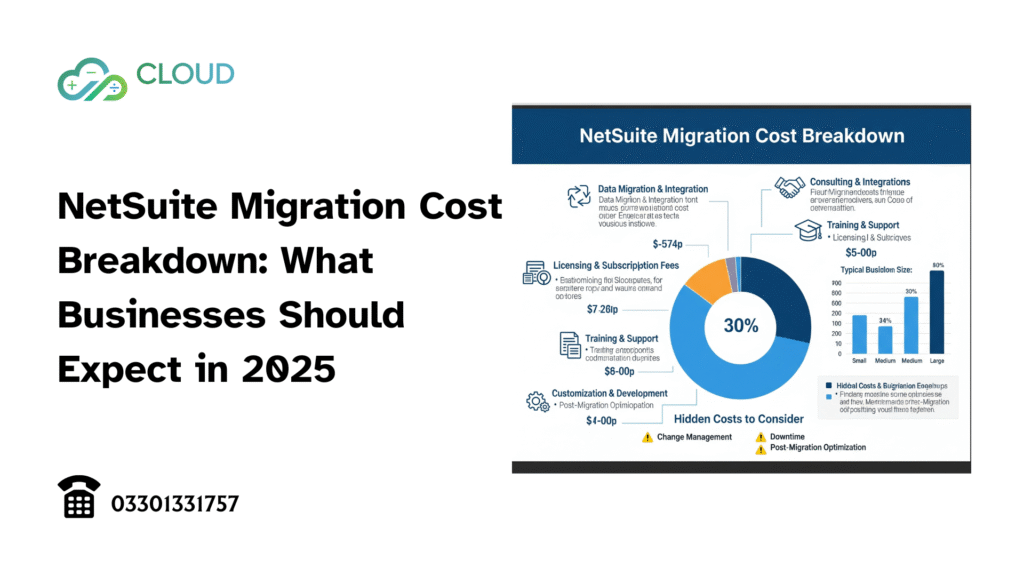
- Licensing and subscription fees – Core NetSuite subscriptions are billed annually and depend on user count.
- Support packages – Many businesses invest in premium support or retainers for external consultants.
- Additional training – As new staff join, training budgets need to be refreshed.
- Unexpected data issues – Poor-quality data can lead to extra hours of correction during migration.
- Upgrades and enhancements – As your business evolves, you may need additional customizations, each adding to the overall NetSuite implementation cost.
By accounting for these, you create a more accurate picture of the cloud ERP cost breakdown and avoid underestimating your true budget.
NetSuite Migration Cost vs Long-Term Value
It’s easy to focus only on the upfront figures, but the bigger picture lies in value. While the NetSuite Migration Cost may feel significant, the long-term ROI often justifies the expense.
Here’s why businesses see value beyond the numbers:
- Time saved – Automating workflows reduces manual data entry.
- Accuracy – Centralized reporting minimizes financial errors.
- Scalability – NetSuite grows with your business, avoiding repeated migrations later.
- Better decision-making – Real-time dashboards improve forecasting and cash flow control.
- Compliance benefits – Automated audit trails reduce regulatory risks.
This is where NetSuite ROI comes into play. When evaluating the cloud ERP cost breakdown, leadership should weigh not only expenses but also how efficiency and automation will pay back the investment over several years.
How Cloud Accounting Helps Manage NetSuite Migration Cost
At Cloud Accounting, we specialize in helping businesses control and optimize their NetSuite Migration Cost. Many projects go over budget simply because companies underestimate complexity or lack the right expertise. Our approach is designed to minimize that risk.
Here’s how we help:
- Structured migration framework – We follow proven steps that reduce errors and duplication.
- Cost-cutting advisory – We identify unnecessary add-ons and guide you toward the modules that deliver the most value.
- Training and support – By ensuring staff are confident from day one, we reduce hidden costs of poor adoption.
- Ongoing partnership – Our experts remain available to support new integrations, avoiding expensive rework.
- SME-friendly solutions – For smaller firms, we create migration plans that keep budgets under control while still ensuring scalability.
With Cloud Accounting, you don’t just get a migration—you get a partner who ensures your NetSuite migration pricing delivers maximum ROI.
Final Thoughts on NetSuite Migration Cost
Every business wants a clear answer to “How much will it cost to move to NetSuite?” While there’s no single figure, the average NetSuite Migration Cost depends on factors like data size, integrations, and training. SMEs may spend tens of thousands, while large enterprises often face six-figure projects.
By planning for hidden expenses and focusing on ROI, businesses can approach migration with confidence. Partnering with specialists like Cloud Accounting ensures your project stays on budget and delivers long-term value.
Now is the time to evaluate whether the investment aligns with your growth strategy.
Contact Cloud Accounting today to discuss your NetSuite migration cost and get a tailored estimate.When companies start considering a switch to NetSuite, one of the first questions is: What will it cost? The answer is not always simple. The NetSuite Migration Cost depends on several factors, from the amount of data you’re moving to the complexity of your integrations. Without a clear understanding, businesses often face unexpected ERP migration expenses that can derail budgets.
Planning for the NetSuite Migration Cost ensures your business avoids nasty surprises. It also gives leadership the confidence to compare upfront costs with long-term gains. In this guide, we’ll break down the major cost drivers, the difference between SME and enterprise pricing, hidden expenses to watch out for, and why the value often outweighs the initial investment.
Why Understanding NetSuite Migration Cost Is Essential
Migrating to a new ERP system is not just a technical upgrade—it’s a transformation that touches every department. Finance, HR, sales, supply chain, and operations all depend on accurate data and smooth processes. If migration costs spiral out of control, the entire project’s success can be at risk.
Businesses that fail to budget carefully often face:
- Delays due to unexpected customizations.
- Overspending on modules they don’t actually need.
- Ongoing consultancy bills long after go-live.
- Staff frustration due to lack of training.
Understanding your NetSuite implementation cost upfront means you can prioritize what matters most, allocate budget correctly, and avoid paying for features that deliver little return.
Key Factors That Drive NetSuite Migration Cost
No two businesses will spend the same amount on a migration. That’s because the NetSuite Migration Cost depends heavily on company size, system requirements, and internal readiness.
The main cost drivers include:
- Data size and quality – Migrating clean, structured data is much faster and cheaper than handling years of disorganized records. If your legacy data needs extensive clean-up, expect higher costs. For example, a company moving only current-year transactions will spend less than one migrating 10 years of history.
- Integrations with existing systems – The more third-party tools (CRM, ecommerce, payroll, inventory) you need to connect, the higher the NetSuite implementation cost. Custom-built integrations often cost more than pre-built connectors.
- Modules required – Some companies only need finance and accounting, while others add supply chain, HR, or advanced reporting. Each module affects pricing.
- Customization and automation – Tailoring workflows, dashboards, and approval rules adds value but increases project hours. Highly regulated industries often need custom compliance features, which add to overall ERP migration expenses.
- Training and change management – Successful migrations don’t stop at go-live. Employee training and adoption support are critical budget items. Skipping this step can lead to hidden productivity costs later.
Each of these elements has a direct impact on your overall NetSuite migration pricing.
Typical NetSuite Migration Cost for SMEs vs Large Enterprises
Budgeting for migration looks very different for a small business compared to a multinational corporation.
- SMEs: A typical small or medium-sized enterprise might spend between $25,000–$75,000 on their migration. The lower cost reflects fewer modules, simpler integrations, and smaller data sets. Startups may fall toward the lower end, while established SMEs with multiple branches may be at the higher end.
- Large enterprises: At the enterprise level, the NetSuite Migration Cost can exceed $150,000–$500,000. Global subsidiaries, compliance requirements, and extensive customization make these projects more complex. Large organizations also tend to need longer historical data migration, adding to costs.
Industry plays a role too. For example:
- Ecommerce businesses may need deep integrations with Shopify, Amazon, or Magento.
- Manufacturers often require advanced inventory and production modules.
- Professional services firms typically invest in time-tracking and project management modules.
Each of these industry-specific requirements pushes the NetSuite migration pricing higher.
Ongoing and Hidden NetSuite Migration Cost Items
Even after go-live, migration-related expenses don’t always stop. Businesses should budget for ongoing costs, as well as potential hidden charges that appear during implementation.
Common ongoing and hidden costs include:
- Licensing and subscription fees – Core NetSuite subscriptions are billed annually and depend on user count.
- Support packages – Many businesses invest in premium support or retainers for external consultants.
- Additional training – As new staff join, training budgets need to be refreshed.
- Unexpected data issues – Poor-quality data can lead to extra hours of correction during migration.
- Upgrades and enhancements – As your business evolves, you may need additional customizations, each adding to the overall NetSuite implementation cost.
By accounting for these, you create a more accurate picture of the cloud ERP cost breakdown and avoid underestimating your true budget.
NetSuite Migration Cost vs Long-Term Value
It’s easy to focus only on the upfront figures, but the bigger picture lies in value. While the NetSuite Migration Cost may feel significant, the long-term ROI often justifies the expense.
Here’s why businesses see value beyond the numbers:
- Time saved – Automating workflows reduces manual data entry.
- Accuracy – Centralized reporting minimizes financial errors.
- Scalability – NetSuite grows with your business, avoiding repeated migrations later.
- Better decision-making – Real-time dashboards improve forecasting and cash flow control.
- Compliance benefits – Automated audit trails reduce regulatory risks.
This is where NetSuite ROI comes into play. When evaluating the cloud ERP cost breakdown, leadership should weigh not only expenses but also how efficiency and automation will pay back the investment over several years.
How Cloud Accounting Helps Manage NetSuite Migration Cost
At Cloud Accounting, we specialize in helping businesses control and optimize their NetSuite Migration Cost. Many projects go over budget simply because companies underestimate complexity or lack the right expertise. Our approach is designed to minimize that risk.
Here’s how we help:
- Structured migration framework – We follow proven steps that reduce errors and duplication.
- Cost-cutting advisory – We identify unnecessary add-ons and guide you toward the modules that deliver the most value.
- Training and support – By ensuring staff are confident from day one, we reduce hidden costs of poor adoption.
- Ongoing partnership – Our experts remain available to support new integrations, avoiding expensive rework.
- SME-friendly solutions – For smaller firms, we create migration plans that keep budgets under control while still ensuring scalability.
With Cloud Accounting, you don’t just get a migration—you get a partner who ensures your NetSuite migration pricing delivers maximum ROI.
Final Thoughts on NetSuite Migration Cost
Every business wants a clear answer to “How much will it cost to move to NetSuite?” While there’s no single figure, the average NetSuite Migration Cost depends on factors like data size, integrations, and training. SMEs may spend tens of thousands, while large enterprises often face six-figure projects.
By planning for hidden expenses and focusing on ROI, businesses can approach migration with confidence. Partnering with specialists like Cloud Accounting ensures your project stays on budget and delivers long-term value.
Now is the time to evaluate whether the investment aligns with your growth strategy.
Contact Cloud Accounting today to discuss your NetSuite migration cost and get a tailored estimate.