At the start, everything feels under control.
You send invoices, track expenses, and check reports without stress. FreshBooks does exactly what you need. It is simple, clean, and easy to use. You don’t need training sessions or technical support. You log in, get your work done, and move on with your day.
In fact, that simplicity is what makes it so appealing in the early stage. There are fewer decisions to make, fewer processes to manage, and fewer people involved. Your financial data is small enough to understand at a glance. Nothing feels overwhelming.
But growth changes the game.
More clients. and transactions. More team members. And suddenly, the same system that once felt perfect starts to feel… tight.
You may not notice it all at once. It usually starts small.
A report takes longer to prepare.
An invoice needs double-checking.
You export data to Excel “just this once.”
Then it becomes a pattern.
As your business expands, your needs become more complex. You are no longer just tracking income and expenses. You are trying to understand performance, control costs, manage teams, and plan ahead.
That’s where the cracks begin to show.
FreshBooks is still doing what it was built to do. The problem is, your business has outgrown that level of simplicity.
This is where the conversation around FreshBooks vs ERP begins.
It is not about replacing a tool for the sake of it. It is about recognising when your system is no longer supporting your growth.
Let’s break down what actually starts to fail as your business grows, and what it means for your next step.
Why FreshBooks Works So Well in the Early Stage
There’s a reason many small businesses start with FreshBooks.
It removes complexity.
You can:
- Create invoices in minutes
- Track expenses without confusion
- Manage basic reports
- Handle simple cash flow
For freelancers, consultants, and small teams, this works beautifully.
And FreshBooks delivers that.
But here’s the catch.
It is built for simplicity, not scale.
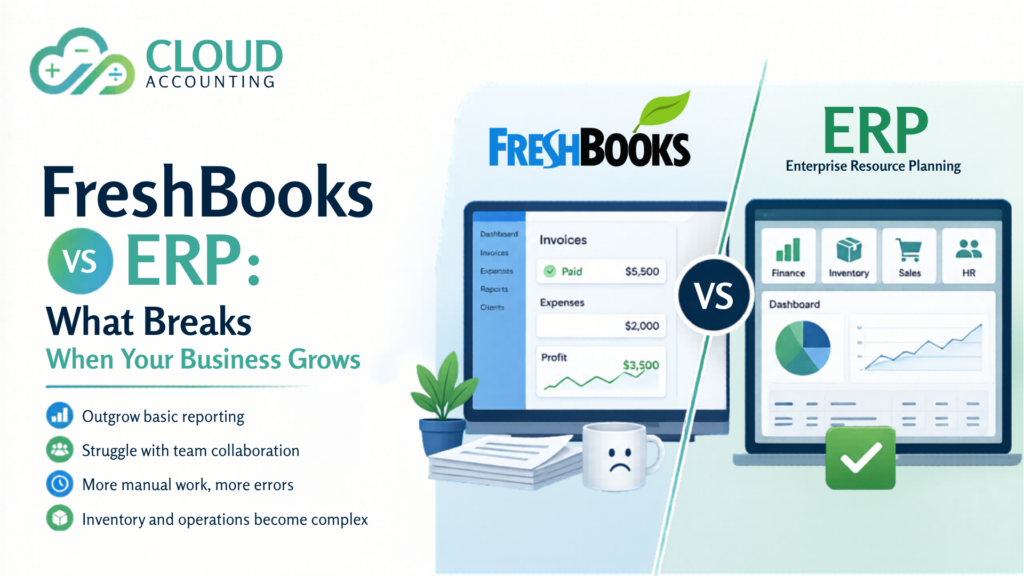
FreshBooks vs ERP: The Real Difference
Before we talk about what breaks, let’s get clear on one thing.
FreshBooks and ERP systems are built for very different purposes.
FreshBooks focuses on:
- Basic accounting
- Invoicing
- Expense tracking
- Simple reporting
ERP systems focus on:
- Full business operations
- Inventory and supply chain
- Advanced financial control
- Multi-department workflows
- Real-time data across teams
So when comparing FreshBooks vs ERP, you are not just comparing tools.
You are comparing stages of business maturity.
What Breaks First: Limited Financial Visibility
At first, basic reports are enough.
But as your business grows, you start asking deeper questions:
- Which product is most profitable?
- Which client segment drives revenue?
- Where are we losing money?
This is where FreshBooks starts to struggle.
You may find:
- Reports are too basic
- Data needs manual adjustments
- Insights are delayed
In a FreshBooks vs ERP scenario, ERP systems win here because they provide:
- Real-time dashboards
- Detailed financial breakdowns
- Custom reporting across departments
Without this, decision-making becomes slower and riskier.
When Team Collaboration Starts to Fail
Growth means more people.
More people means more coordination.
FreshBooks is not designed for complex team structures. You may notice:
- Limited user roles
- Lack of approval workflows
- No clear audit trails
This creates confusion.
Who approved this expense?
Why was this invoice changed?
Who is responsible for this data?
ERP systems solve this with:
- Role-based access
- Approval chains
- Activity tracking
This is a major shift in the FreshBooks vs ERP discussion.
Manual Work Starts Taking Over
Here’s something most businesses don’t expect.
As you grow, your workload doesn’t just increase. It multiplies.
You might start:
- Exporting data to spreadsheets
- Rechecking numbers manually
- Fixing mismatched reports
This leads to:
- Wasted time
- Higher risk of errors
- Frustration across teams
FreshBooks keeps things simple, but that simplicity becomes a limitation.
ERP systems reduce manual work by:
- Automating processes
- Connecting departments
- Keeping data consistent
In the FreshBooks vs ERP comparison, this is where efficiency becomes a big factor.
Inventory and Operations Become a Problem
If your business deals with products, things get more complex.
FreshBooks has very limited inventory features.
You may struggle with:
- Tracking stock levels
- Managing multiple locations
- Handling purchase orders
And this affects more than just inventory.
It impacts:
- Sales
- Accounting
- Customer satisfaction
ERP systems are built to handle this.
They connect inventory with finance, sales, and purchasing in one place.
This is one of the biggest breaking points in the FreshBooks vs ERP journey.
Scaling Across Locations Gets Messy
Growth often means expansion.
New branches. New markets. Maybe even new countries.
FreshBooks is not built for this level of complexity.
You may face:
- Difficulty managing multiple entities
- Limited currency handling
- No consolidated reporting
ERP systems, on the other hand, support:
- Multi-entity structures
- Multi-currency transactions
- Centralised reporting
So when comparing FreshBooks vs ERP, scaling becomes a clear dividing line.
Data Becomes Hard to Trust
At a small scale, small errors are manageable.
At a larger scale, they are dangerous.
Manual processes, disconnected systems, and limited controls can lead to:
- Inconsistent data
- Duplicate entries
- Reporting errors
And once trust in your data drops, decision-making suffers.
ERP systems fix this by:
- Centralising data
- Enforcing consistency
- Providing audit trails
This is not just a technical upgrade. It is a business safeguard.
The Hidden Cost of Staying Too Long
Many businesses delay moving away from FreshBooks.
It feels familiar. It feels safe.
But staying too long can cost more than switching.
You may not notice it immediately, but over time:
- Productivity drops
- Errors increase
- Growth slows down
The longer you wait, the harder the transition becomes.
In the FreshBooks vs ERP decision, timing matters more than most people think.
When Should You Consider Moving to ERP?
You don’t need to switch the moment you grow.
But there are clear signs that it is time.
Watch for these:
- You rely heavily on spreadsheets
- Reports take too long to prepare
- Your team struggles with coordination
- You handle inventory or multiple locations
- Financial insights are not clear
If you are ticking more than two or three of these, it is time to think seriously about ERP.
FreshBooks vs ERP: It’s Not About Better, It’s About Fit
Let’s be clear.
FreshBooks is not a bad system. In fact, for many small businesses, it is exactly the right place to start. It keeps things simple, reduces confusion, and helps you stay on top of your finances without needing deep technical knowledge.
But it is built for a specific stage.
A stage where:
- Transactions are manageable
- Teams are small
- Processes are simple
- Decisions do not rely on complex data
ERP systems are different.
That means more control. But it also means more structure.
So when comparing FreshBooks vs ERP, it is not about which one wins.
It is about timing.
Ask yourself:
- Is your current system still helping you move faster?
- Or is it starting to slow you down?
- Are you working with your system, or working around it?
Because once you start building workarounds, that is a sign something no longer fits.
The real question is not:
Which is better?
The real question is:
Which fits your business right now?
And just as important:
Will it still fit where your business is heading next?
How Cloud Accounting Can Help You Transition
Moving from FreshBooks to an ERP system is not just a technical change.
It is a business shift.
You are moving from a simple setup to a system that controls how your entire business runs. If this step is rushed or handled poorly, it can create more problems than it solves.
That is why planning matters.
It is not just about switching software. It is about:
- Cleaning and preparing your data so nothing important is lost
- Choosing the right ERP system based on how your business actually works
- Setting up workflows that match your operations, not force you to adapt blindly
- Training your team so they can use the system with confidence from day one
This is where Cloud Accounting makes a real difference.
- Assess your current system and identify what is holding you back
- Map out a clear migration plan with realistic timelines
- Avoid common mistakes that lead to delays or data issues
- Set up your new system in a way that supports growth
- Ensure your data stays accurate, structured, and easy to trust
- Support your team during and after the transition
You do not need to figure this out alone.
With the right guidance, moving from FreshBooks to ERP becomes a smart, controlled step forward instead of a risky leap.
Final Thought
Growth is exciting.
But it also puts pressure on everything behind the scenes.
What once worked smoothly can start to feel stretched. Small gaps turn into daily frustrations. Simple tasks take longer than they should.
That is how you know it is time to pay attention.
The FreshBooks vs ERP decision is one of those turning points where you need to step back and look at the bigger picture.
Not just your accounting. Your entire operation.
If your system is slowing you down, creating extra work, or limiting your visibility, it is no longer just a software issue.
It is a business issue.
And the sooner you fix it, the faster your business can move forward with confidence.
Call to Action
Outgrowing FreshBooks is not a problem. It is a sign your business is moving forward.
But waiting too long can slow you down.
If you are starting to see the limits, now is the right time to act.
Cloud Accounting will help you:
- Review your current setup
- Identify what is holding you back
- Plan a smooth move to the right system
- Keep your data clean, accurate, and secure
No guesswork. No confusion. Just a clear path forward.
Ready to take the next step?
Get in touch today and let’s find the right system for your growing business.