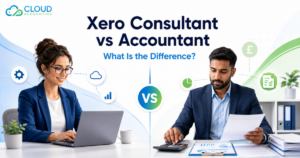
Choosing between a Xero consultant and an accountant can feel confusing. Both may work with the same financial data, use the same accounting software and help improve your records. However, their main responsibilities are different.
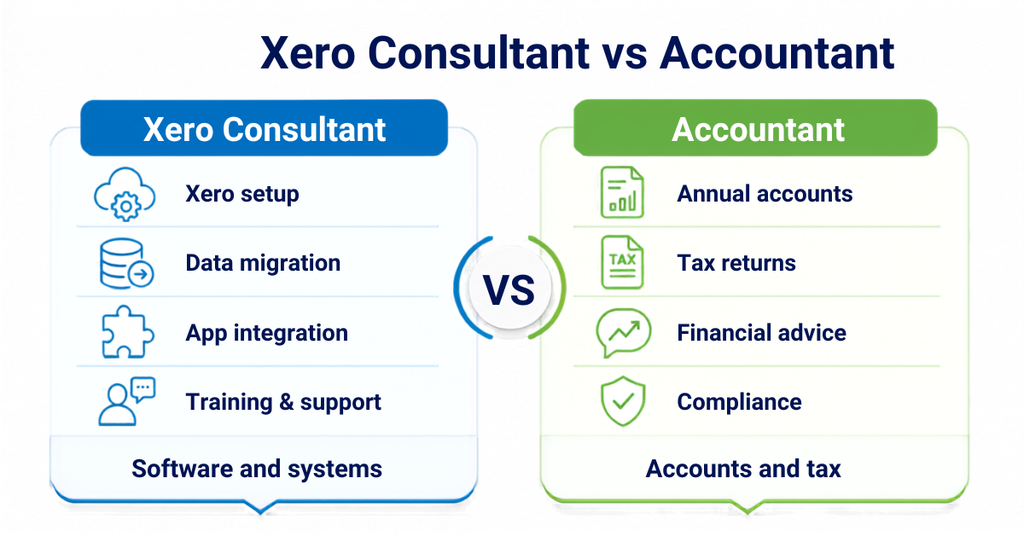
A Xero consultant usually focuses on how your business uses Xero. They may help with setup, migration, training, integrations, reporting and fixing system problems.
An accountant focuses more on your financial records, tax responsibilities, annual accounts and financial advice. Some accountants are also highly experienced Xero consultants, but this is not always the case.
Understanding the Xero Consultant vs Accountant difference can help you choose the right support, avoid paying for unnecessary work and prevent important tasks from falling through the cracks.
What Is a Xero Consultant?
A Xero consultant is a specialist who helps businesses set up, manage and improve their use of Xero.
Their work usually focuses on the software, the flow of financial information and the processes used by your team. They look at whether Xero has been configured correctly and whether it supports the way your business operates.
A Xero consultant may help with:
- Setting up a new Xero organisation
- Moving accounting data from another platform
- Designing or restructuring the chart of accounts
- Configuring VAT settings
- Setting up bank feeds and reconciliation rules
- Creating invoice and payment processes
- Selecting and connecting Xero apps
- Improving financial reports
- Training business owners and employees
- Troubleshooting Xero errors
- Reviewing user access and permissions
- Correcting problems after a failed migration
Xero supports functions such as invoicing, bank reconciliation, reporting, VAT returns, payroll, projects, expenses and app connections. A consultant helps businesses decide which of these tools to use and how to configure them properly. Xero’s official feature guide provides an overview of the platform’s current capabilities.
A consultant’s role is often practical and project-based. For example, a business may hire one to move five years of data from Sage to Xero, connect an ecommerce store or train a finance team.
What Is an Accountant?
An accountant helps a business understand, manage and report its financial position.
The accountant’s exact responsibilities depend on their qualifications, experience and the services included in the engagement. Their work may involve routine accounting, tax reporting, compliance and wider financial advice.
An accountant may help with:
- Preparing annual accounts
- Completing Corporation Tax returns
- Advising on allowable business expenses
- Reviewing bookkeeping records
- Preparing management accounts
- Supporting budgeting and cash-flow planning
- Reviewing business performance
- Advising on business structure
- Helping with tax planning
- Supporting HMRC enquiries
- Preparing or reviewing VAT returns
- Advising directors on financial decisions
Some accountants also provide bookkeeping, payroll, software setup and Xero training. Others focus mainly on year-end accounts and tax.
It is important to check a provider’s qualifications and the work they are authorised to perform. For example, “chartered accountant” is a recognised professional designation with defined qualification routes and professional oversight in the UK. The UK Regulated Professions Register provides further information.
Xero Consultant vs Accountant: Quick Comparison
| Area | Xero Consultant | Accountant |
| Main focus | Xero software and accounting processes | Financial records, tax and financial advice |
| Xero setup | Usually a core service | May be offered |
| Data migration | Often a specialist service | May assist or refer it |
| App integration | Common area of support | Not always included |
| Xero training | Often provided | Depends on the accountant |
| Annual accounts | Usually not the main role | Common service |
| Tax returns | Usually outside the main role | Common service |
| Management reporting | Builds or improves report setup | Reviews and explains financial results |
| Troubleshooting | Fixes software and configuration problems | Corrects accounting or tax treatment |
| Typical engagement | Project-based or ongoing support | Monthly, quarterly or annual |
| Professional qualification | Varies by consultant | Varies; may hold an accounting qualification |
The key point is simple: a Xero consultant usually helps make the system work correctly, while an accountant helps make sure the financial records and reporting are correct.
Does a Xero Consultant Need to Be an Accountant?
Not necessarily.
“Xero consultant” describes the service someone provides. It does not automatically mean that the person is a qualified accountant. A consultant may have strong experience in data migration, system setup, reporting, automation or staff training without offering tax or statutory accounting services.
Likewise, being an accountant does not automatically mean someone is a specialist in complex Xero work.
A capable accountant may use Xero every day but have limited experience with:
- Large historical data migrations
- Complex app integrations
- Multi-entity configurations
- Ecommerce accounting systems
- Advanced tracking structures
- Migration error correction
- Custom reporting workflows
- Large-volume transaction imports
Xero certifications and badges indicate knowledge of Xero products, but they should not be treated as replacements for professional accounting qualifications. Xero states that firms in its advisor directory have trained staff and at least eight clients using Xero. That is useful evidence of platform experience, but businesses should still check the provider’s individual services and relevant experience. Xero Advisor Directory.
The strongest provider for a particular project may have both accounting knowledge and advanced Xero experience.
Where Do Their Responsibilities Overlap?
The Xero Consultant vs Accountant comparison is not always a clean split. Several tasks may involve both roles.
Chart of accounts
A consultant can build or restructure the chart of accounts inside Xero. However, an accountant may need to advise how income, costs, assets and liabilities should be classified.
VAT setup
A consultant may configure VAT rates, tax settings and relevant workflows. An accountant should advise on the correct VAT treatment where professional tax judgement is required.
Financial reporting
A consultant can create report layouts, tracking categories and dashboard views. An accountant can interpret the figures and explain what they mean for the business.
Data migration
A Xero consultant may extract, map, import and validate the data. An accountant may review trial balances, outstanding balances and tax positions before final approval.
Month-end processes
A consultant can design a practical month-end checklist and introduce automation. An accountant can review the resulting records, post necessary adjustments and prepare management accounts.
The two roles often work best together. One deals with the system and data process; the other provides accounting judgement and financial oversight.
When Should You Hire a Xero Consultant?
A Xero consultant may be the right choice when your main problem is related to the software, migration or working process.
Consider hiring one if:
You are moving to Xero
Moving from Sage, QuickBooks, FreeAgent, NetSuite or another system involves much more than uploading a spreadsheet.
Your records may include contacts, invoices, bills, credit notes, payments, journals, bank transactions and opening balances. These items must be mapped carefully and checked after the migration.
A consultant can plan the conversion, prepare the data and compare the migrated balances with the source records.
Your Xero setup is causing problems
Your software may technically be running while the setup behind it is creating extra work.
Examples include:
- Duplicate account codes
- Incorrect VAT rates
- Unreconciled transactions
- Poorly structured tracking categories
- Duplicate contacts
- Incorrect opening balances
- Unclear user permissions
- Reports that do not match business needs
A consultant can review the setup, identify the cause and recommend corrections.
You need to connect another system
Your business may use ecommerce platforms, payment processors, inventory tools, expense apps or customer management software.
A consultant can review what information needs to move between each platform. They can also help you avoid duplicate transactions, missing sales, incorrect fees and confused clearing-account balances.
Your team needs Xero training
Training should reflect how your team actually uses the software.
A consultant can show staff how to raise invoices, enter bills, reconcile payments, manage expenses, correct mistakes and run reports. This can reduce repeated errors and dependence on one team member.
Your accountant does not provide technical Xero support
Some accountants focus on tax and year-end compliance. They may not offer migration, app setup, advanced training or technical problem-solving.
A Xero consultant can fill this gap while continuing to work alongside your accountant.
When Should You Hire an Accountant?
An accountant is usually the better choice when your question requires financial judgement, tax knowledge or formal accounting work.
You may need an accountant if:
- Your annual accounts are due
- You need to file a Corporation Tax return
- You require tax planning
- Your bookkeeping records need professional review
- You need management accounts
- You are unsure how a transaction should be treated
- You are changing your business structure
- You need help responding to HMRC
- You want financial advice before making a major decision
- You require year-end adjustments
For example, a consultant can show you where to enter a transaction in Xero. An accountant should advise whether the transaction is a business expense, an asset, a director’s loan or something else.
That difference matters. Software can record a decision, but it cannot make every professional judgement for you.
Do You Need Both?
Many growing businesses benefit from using both a Xero consultant and an accountant.
Imagine that a company wants to move from Sage 50 to Xero.
The Xero consultant may:
- Review the source data.
- Agree on the migration period.
- Map the chart of accounts.
- Configure the new Xero organisation.
- Import the agreed records.
- Compare key balances.
- Train the internal team.
The accountant may:
- Review the proposed accounting structure.
- Confirm the opening or closing figures.
- Advise on VAT and tax treatment.
- Review any year-end adjustments.
- Use the migrated data for accounts and tax work.
This shared approach gives the business technical support and professional financial oversight. It also reduces the risk of assuming one provider is handling a task that sits outside their agreed scope.
Can Your Accountant Also Be Your Xero Consultant?
Yes, if they have the right experience and provide the services you need.
Some accounting firms offer a complete service covering setup, bookkeeping, reporting, tax and Xero support. This can be useful because one team already understands the business and its financial records.
However, ask direct questions before appointing them:
- How many Xero migrations have you completed?
- Which accounting systems have you migrated from?
- Can you move detailed historical transactions?
- How do you validate migrated balances?
- Do you provide Xero training?
- Can you recommend and configure connected apps?
- Who will manage technical problems?
- Is post-migration support included?
- Which accounting and tax services are included?
- What work is excluded from the quote?
A familiar accountant is not automatically the right migration specialist. Equally, a technically skilled consultant is not automatically qualified to provide tax advice. Job titles can wear impressive hats; evidence matters more.
How to Choose the Right Xero Consultant
A good consultant should understand more than where the buttons are located.
Look for someone who:
- Takes time to understand your business
- Explains the proposed scope clearly
- Has experience with similar projects
- Reviews the quality of your existing data
- Sets realistic expectations
- Explains what can and cannot be migrated
- Uses structured validation checks
- Protects access to financial information
- Provides clear training or handover
- Offers defined support after completion
For migrations, ask how the consultant checks the trial balance, customer balances, supplier balances, bank positions and tax balances. An import being marked “complete” does not prove that the figures are correct.
You should also receive written confirmation of the work included, the expected timescale, your responsibilities and any limitations.
How to Choose the Right Accountant
When choosing an accountant, consider:
- Their professional qualifications
- Experience with your industry
- Knowledge of UK tax and reporting requirements
- Familiarity with businesses of your size
- Experience using Xero
- Services included in the fee
- Communication and response times
- Whether they provide proactive advice
- Who will complete the day-to-day work
- How they protect your information
You should also ask whether bookkeeping, payroll, VAT returns, annual accounts, Corporation Tax and personal tax are included or charged separately.
A low starting fee can become expensive if every routine question appears as a separate charge.
Questions to Ask Before Hiring Either Provider
Before making your decision, ask:
- What services are included?
- What services are excluded?
- Who will carry out the work?
- What relevant qualifications or Xero certifications do they hold?
- Have they handled a similar business or project?
- How will they check the accuracy of the work?
- What information do they need from you?
- How long will the project take?
- What happens if unexpected problems are found?
- Will support be available after the work is completed?
Clear answers at the beginning can prevent uncomfortable surprises later.
Xero Consultant vs Accountant: Which One Should You Choose?
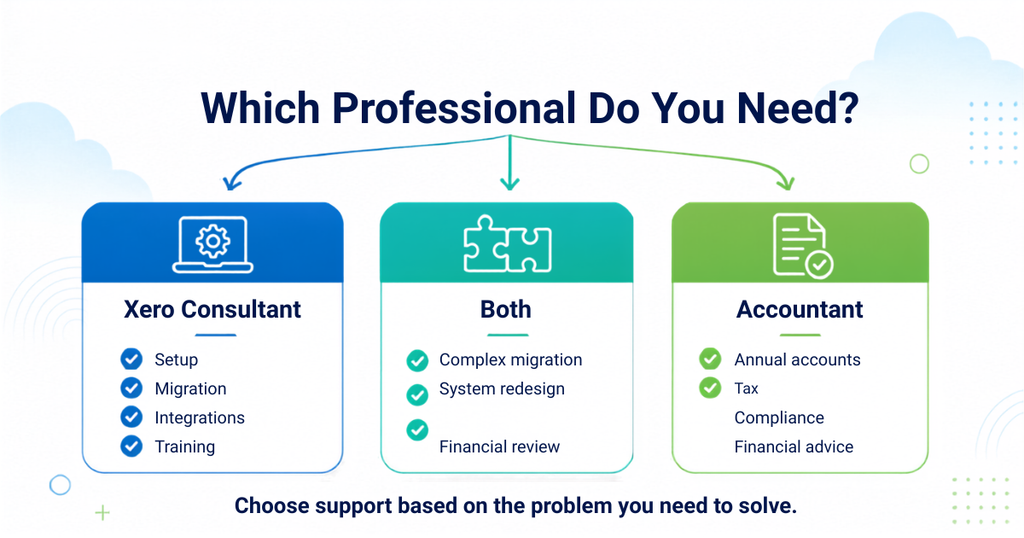
The right choice depends on the problem you need to solve.
For software-related support, a Xero consultant can help with:
- Xero setup
- Data migration
- Software training
- App integration
- Reporting configuration
- Process improvement
- Technical troubleshooting
- Migration correction
Choose an accountant when you need help with:
- Annual accounts
- Tax returns
- Tax advice
- Financial review
- Management accounts
- Business planning
- Accounting treatment
- HMRC matters
Choose both when a project involves technical Xero work and professional accounting judgement.
For example, a complex migration, business restructure or major system redesign may require both skills. Getting the right people involved early can prevent expensive corrections later.
Frequently Asked Questions
Is a Xero consultant the same as a Xero accountant?
No. A Xero consultant mainly focuses on the software, data and business processes. A Xero accountant generally focuses on accounting records, reporting, tax and financial advice. One person or firm may provide both services.
Can a Xero consultant prepare annual accounts?
Only if the consultant also offers suitable accounting services and has the necessary competence for the work. Never assume annual accounts or tax returns are included in a Xero consultancy project.
Can an accountant complete a Xero migration?
Some accountants can complete Xero migrations, particularly straightforward conversions. More complex projects may require a consultant with specialist experience in data extraction, mapping, imports and validation.
Is Xero certification an accounting qualification?
No. Xero certification demonstrates knowledge of Xero products. It is not the same as a professional accounting qualification.
Who should fix errors in Xero?
It depends on the error. A consultant can usually address software setup, migration and workflow problems. An accountant should handle questions that require accounting or tax judgement. Complex issues may require both.
How much does a Xero consultant cost?
Fees depend on the project scope, data volume, complexity and level of support. A basic setup may cost less than a historical migration, multi-company project or complex app integration. Request a written quote based on your actual requirements.
Should my Xero consultant work with my accountant?
Yes. Cooperation helps ensure that the Xero setup supports your accounting needs and that key balances receive the right review. It also makes responsibilities clearer.
Final Thoughts
The main Xero Consultant vs Accountant difference comes down to focus.
A Xero consultant helps you build, improve or repair the system you use to manage financial information. An accountant reviews that information, applies accounting and tax knowledge, and helps you meet your reporting responsibilities.
Neither role automatically replaces the other.
Before hiring anyone, define the result you need. Check their experience, qualifications and project scope. Most importantly, confirm who is responsible for each part of the work.
Need Help With Your Xero Setup?
Cloud Accounting can help with Xero setup, data migration, training, app integration, reporting and migration correction. We can also work alongside your existing accountant to make sure your Xero system supports the way your business operates.
Book a discovery call with Cloud Accounting to discuss your Xero requirements and find the right support for your business.