A successful software migration is not simply about moving figures between platforms. The real challenge is protecting the accuracy of accounting records while maintaining reliable financial reporting throughout the change. Before starting a Xero Migration Service, businesses need to examine their chart of accounts, review financial data, and understand how existing accounting workflows will operate in the new system. In practice, problems often arise when bank reconciliation, tax settings, or account structures are overlooked. A careful approach to data migration helps preserve essential information, reduce accounting errors, and support better business decisions after the transition.
The value of a migration becomes clearer when businesses consider what happens after the initial transfer. Reliable system configuration, accurate transaction processing, and appropriate user permissions all contribute to dependable day-to-day accounting. Experienced accounting professionals also examine software compatibility, accounting integrations, and financial records before recommending changes. Where complex records are involved, migration expertise, practical experience, and professional competence matter more than a certificate alone. Combining these skills with proper client onboarding, data security, and financial management gives businesses a stronger foundation for ongoing reporting and growth.
Before starting a Xero Migration Service, businesses need to examine their chart of accounts, review financial data, and understand how existing accounting workflows will operate in the new system.
What Is Xero Certification?
A Xero certification shows that someone has developed recognised skills in using the platform, but it does not automatically make them an expert in moving complex accounting records. A Xero Certified Adviser completes a training process involving learning modules and an assessment designed to test their understanding of everyday accounting tasks. For accountants, bookkeepers, and finance professionals, this provides a structured way to build software knowledge and demonstrate software proficiency. However, when choosing someone to manage a migration, businesses should also consider their ability to identify data errors, handle historical transactions, and explain differences between the old and new systems.
The distinction matters because cloud accounting skills and migration experience are not quite the same thing. A professional may understand financial management and hold an online credential, yet still need further practical accounting experience to handle complicated conversions. Xero offers a free learning programme that supports professional development, while additional specialist training can help strengthen migration-related knowledge. For finance teams reviewing a potential service provider, the useful question is whether that person’s professional qualifications, business advisory experience, and professional credibility are supported by evidence of completed migration projects. Certification is valuable, but accurate migration work also depends on sound judgement and careful checking.
Types and Levels of Xero Certification
Not every certification reflects the same depth of accounting knowledge. Xero’s learning structure distinguishes Level 1 Associate, which focuses on fundamental accounting tasks, from Level 2 Professional, which develops the ability to handle complex accounting activities. Level 3 Specialist represents a further area of advanced specialisation, although its current availability and requirements should be checked against Xero’s official training programme. These certification levels help professionals understand their learning pathways, but a higher level does not automatically establish competence in every accounting situation. For example, someone with strong advanced accounting skills may still require specific migration training before transferring historical transactions between systems. Xero’s learning structure distinguishes Level 1 Associate, which focuses on fundamental accounting tasks, from Level 2 Professional, which develops the ability to handle complex accounting activities.
For businesses considering a move to Xero, the more useful distinction is between general core adviser certification and focused specialist credentials. Areas such as payroll certification, practice management, and app-related credentials address different professional responsibilities, while migration certification is particularly relevant to accounting software migration. The term Xero Migration Specialist Certification relates to specialist migration knowledge, but its exact status should be verified rather than assumed to represent a separate qualification. Professionals may also pursue specialist learning paths, payroll training, and wider professional certification to strengthen their software expertise. These areas support different aspects of advisory services, so businesses should assess the actual work completed by a specialist, not simply the number of specialist badges or accounting qualifications they hold.
How to Become Xero Certified
Becoming Xero certified is less about collecting a qualification and more about demonstrating that you can handle real accounting tasks accurately. Before choosing between different certification pathways, consider your professional experience and career goals, particularly if you intend to work on accounting migrations. Xero provides a learning platform where users can access practical courses, review learning objectives, and develop their understanding of the software. Depending on your circumstances, you may use employer access or pursue independent learning. Optional third-party training can provide additional support, but it is not a requirement for Xero’s official certification. The important distinction is that general software training builds familiarity with the platform, while practical accounting skills help you recognise problems that may affect financial records during a migration.
The certification process generally involves creating an account, completing the relevant registration, obtaining training access, and working through the required training modules. Candidates then demonstrate their understanding through an online assessment, with successful assessment completion leading to the applicable digital certificate or certification badge. However, course completion alone should not be confused with proven migration experience. Anyone planning to specialise in moving accounting records should examine the relevant certification requirements and practise reviewing opening balances, transaction histories, and reconciliation differences. These activities help connect technical learning with the judgement needed to manage an actual migration project.
Optional third-party training can provide additional support, but it is not a requirement for Xero’s official certification.
Xero Certification Training and Curriculum
A useful way to judge Xero training is to consider whether someone can explain why two reports disagree, rather than simply demonstrate where to click. The certification curriculum develops practical understanding of account setup, bank reconciliation, and financial reporting, alongside everyday accounting transactions. For example, an incorrect opening balance may appear to be a reporting problem when the underlying issue involves the chart of accounts or tax settings. Effective cloud accounting training therefore needs to connect transaction processing with financial statements and the treatment of financial records. These are particularly important skills when preparing historical information for a Xero migration, where an apparently minor mapping error can affect several reporting periods.
The wider curriculum also covers how businesses manage contacts, invoicing, payroll, and user management within their accounting environment. Depending on the region and applicable learning materials, topics may include GST reporting and BAS reporting, while organisation setup and banking help learners understand how financial information moves through the system. For migration work, practical accounting tasks are more valuable when they involve realistic examples of incomplete records, incorrect balances, and inconsistent bookkeeping processes. A combination of comprehensive training, flexible learning, and strong accounting software skills can help professionals assess whether imported figures are reliable before they become part of a business’s ongoing accounts.
Xero provides a learning platform where users can access practical courses, review learning objectives, and develop their understanding of the software.
Xero Certification Exam and Assessment
Passing a certification exam demonstrates an understanding of Xero, but it does not necessarily prove that someone can manage a complicated accounting migration. The online assessment evaluates software knowledge through assessment questions that may involve multiple-choice questions, practical scenarios, and familiar platform functions, depending on the certification pathway. A candidate might understand how to correct an invoice yet struggle to identify why imported balances differ from the original system. This is where practical accounting knowledge becomes important. Rather than memorising accounting software functions, professionals should use the available learning material to understand how transactions affect financial reports and why accurate reconciliation matters.
The wider examination framework is designed to assess software proficiency and understanding of relevant certification requirements. Candidates work through learning modules before demonstrating their knowledge, while integration-related tasks may feature in relevant specialist learning. Successful assessment completion supports the award of applicable digital credentials, although the precise certification process depends on the learning pathway. For migration specialists, knowledge assessment should be considered alongside practical experience with historical records, opening balances, and data validation. A structured training evaluation can establish professional competence in using Xero, but handling difficult migration exceptions requires judgement developed through actual accounting work.
Xero Certification Cost and Time
The real expense of becoming Xero certified is often the time spent learning, rather than the price of the qualification. Xero provides free certification through its official training, making it accessible to accounting professionals without compulsory paid courses. However, learning duration varies according to prior knowledge, the chosen pathway, and the amount of practice required. Someone familiar with cloud bookkeeping may complete core adviser certification more quickly than a beginner. Although six to eight hours is sometimes used as an estimate, actual training hours can differ. Professionals should consider their time investment, available employer access, and learning requirements rather than assuming that every candidate will finish within the same period.
The financial picture changes when someone wants deeper expertise in Xero migrations. Optional third-party training may introduce additional training expenses, while migration specialist training can require more preparation than general online learning. Before paying for a course, it is worth checking whether its certification costs cover an official Xero credential or only the training provider’s own certificate. The certification duration also depends on the material covered and the learner’s existing accounting experience. For professionals handling historical data transfers, the strongest professional benefits often come from combining specialist certification with practical exercises, rather than focusing solely on certification completion. This approach makes professional development more relevant to the work clients actually need.
Benefits of Xero Certification
The strongest benefit of Xero certification is not simply having another qualification on a CV. It is the ability to demonstrate software proficiency when handling real accounting responsibilities. For accountants, bookkeepers, and other finance professionals, recognised training can strengthen professional credibility and create new employment opportunities. However, certification becomes more valuable when supported by practical experience, particularly in Xero migrations where historical transactions, opening balances, and reconciliation differences require careful attention. This combination can support career development and give employers greater confidence in a professional’s ability to work with accounting data.
Certification can also influence how clients assess an accounting specialist. A recognised qualification offers professional recognition, while proven software expertise helps establish client trust during complex system changes. For accounting professionals working towards career progression, ongoing professional development provides opportunities to improve technical knowledge and respond to changing client requirements. In a migration project, explaining why figures do not match often matters more than demonstrating basic software features. Professionals who can investigate those differences and communicate the findings clearly are better positioned to build client confidence and contribute to business growth.
Maintaining and Renewing Xero Certification
A Xero qualification should reflect current working knowledge, not simply the date someone first passed an assessment. For professionals handling accounting migrations, software changes can affect how transactions are imported, reconciled, and reported. Maintaining certification status therefore involves checking the applicable certification requirements, following product updates, and revisiting relevant learning resources. Xero certification has historically involved 12-month validity and certification renewal, but professionals should confirm the current rules for their specific credential. The more useful habit is ongoing learning: reviewing new features against real accounting scenarios rather than assuming familiar processes still work in exactly the same way.
In practice, certification maintenance is closely connected to the quality of accounting work. A change to bank reconciliation, tax treatment, or reporting can expose gaps in software knowledge, particularly when migrating older records into a newer system. Regular product learning, supported by continuous professional development, helps practitioners maintain their professional competence and respond to changing client needs. Xero’s learning updates and quarterly learning activities, where applicable, can provide opportunities to refresh accounting skills. Professionals should also monitor renewal requirements and verify their credentials before representing themselves as currently certified, especially when advising clients on complex financial data transfers.

Career Opportunities and Professional Development
A Xero qualification can open doors, but employers often value the ability to solve accounting problems more than the certificate itself. For finance professionals pursuing employment opportunities, recognised software proficiency can strengthen employment applications, particularly when combined with practical experience in reconciliations, financial reporting, and system migrations. This matters for accountants and bookkeepers considering remote work, consulting, or specialist accounting roles. A candidate who understands accounting technology and can explain how financial records move between systems may offer more value than someone familiar only with routine software functions. Developing cloud accounting skills alongside recognised professional qualifications can also support career prospects in businesses adopting digital accounting systems.
Career growth becomes more meaningful when learning is connected to increasingly complex responsibilities. An accounts assistant might begin with bookkeeping and reconciliation tasks, while a graduate accountant or payroll administrator may develop expertise in reporting, payroll processes, or client support. For students, career changers, and international applicants, Xero knowledge can complement existing accounting education, although certification alone does not guarantee employment or international recognition. Continued professional development helps practitioners respond to changing employer requirements and build digital accounting skills relevant to modern finance teams. Those interested in Xero migration can extend their knowledge through specialist training, developing the judgement needed to review historical balances, identify conversion errors, and support clients moving from other accounting platforms. An accounts assistant might begin with bookkeeping and reconciliation tasks, while a graduate accountant or payroll administrator may develop expertise in reporting, payroll processes, or client support.
Client Trust, Accounting Advice and Practical Experience
A successful Xero migration is not measured simply by how much data reaches the new system. It is measured by whether the figures remain reliable enough to support business decisions. Strong client trust develops when an adviser can explain discrepancies, demonstrate problem solving, and connect technical corrections with meaningful accounting advice. For example, an incorrect opening balance may distort cash flow reporting and influence financial planning, even when the software appears to be working correctly. This is where practical experience and accounting expertise become more important than basic software knowledge. Clients need professionals who understand the relationship between historical transactions, financial management, and the quality of information used for future decisions.
A Xero certification can demonstrate software competence, but delivering reliable migration work requires sound judgement and clear communication. Experienced advisers examine financial records, review accounting processes, and identify opportunities for process improvement before recommending changes. Their business advisory capability becomes particularly valuable when migration errors affect management reporting, tax planning, or wider business performance. Rather than treating every issue as a technical fault, effective advisory services consider the commercial impact and provide appropriate business support. This approach strengthens client relationships, builds professional credibility, and helps establish a lasting professional reputation based on the accuracy of the work rather than certification alone.
Understanding Xero Certification
Xero Certification is an official training and assessment programme designed for accountants, bookkeepers, and finance professionals who want to develop practical skills in Xero accounting software. The programme covers essential accounting tasks, including bank reconciliation, invoicing, financial reporting, account setup, and managing financial records. Successful completion provides a recognised credential that demonstrates knowledge of Xero’s features and accounting workflows. However, professionals should combine certification with practical accounting experience, particularly when handling complex financial records or accounting software migrations.
Xero Certification Costs and Training Access
Xero offers free official certification training through its learning platform, allowing eligible professionals to develop their software knowledge without paying a course fee. Learners can access training materials, complete assessments, and earn certification based on their understanding of Xero’s accounting functions. The time required depends on previous accounting experience, familiarity with cloud accounting, and the selected learning pathway. Independent training providers may charge for additional workshops or practical courses, but these are generally optional rather than a requirement for official certification.
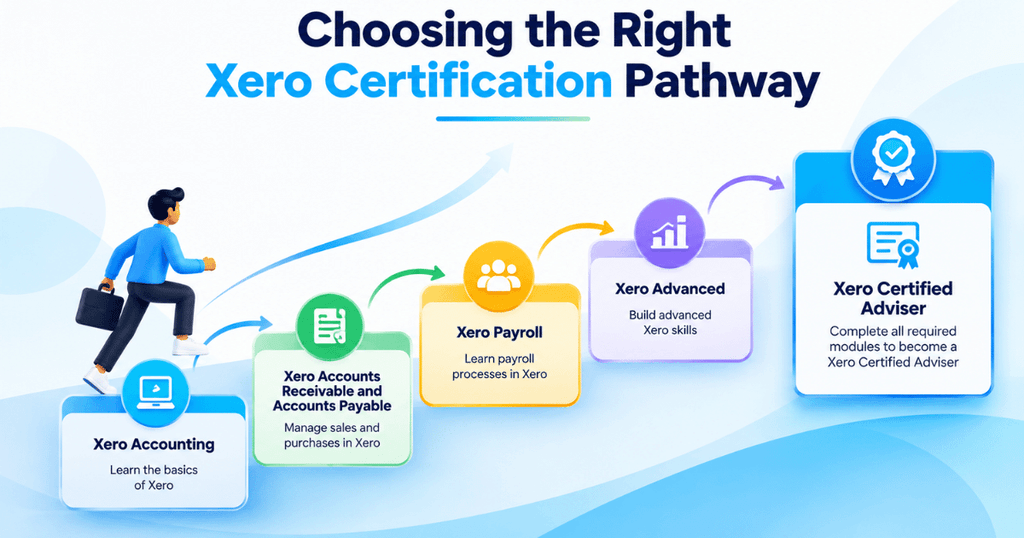
Choosing the Right Xero Certification Pathway
Beginners should start with Xero’s introductory certification pathway to build a strong understanding of everyday accounting functions. This includes creating invoices, reconciling bank transactions, managing contacts, and preparing financial reports. Professionals with existing accounting experience can progress towards more advanced learning in payroll, reporting, or accounting software migration. Those planning to specialise in Xero migration services should also develop practical skills in historical data transfers, opening balance reconciliation, account mapping, and financial data validation.
Maintaining and Renewing Xero Certification
Xero Certification requires ongoing attention to software developments, professional learning, and applicable renewal requirements. The exact renewal process depends on the credential and Xero’s current certification policies. Certified professionals should regularly review their certification status through Xero’s official learning platform and complete any required learning activities. Maintaining up-to-date knowledge helps accountants and bookkeepers understand changes to reporting tools, bank reconciliation, tax settings, and accounting workflows. For migration specialists, this knowledge is particularly important when transferring historical financial records between different accounting systems.
Understanding Xero Partner Tiers and Service Quality
Xero’s partner programme recognises accounting firms through different partnership levels, including Silver, Gold, and Platinum. Higher partner tiers generally indicate greater engagement with the Xero ecosystem, but they do not automatically guarantee better accounting advice or technical expertise. Businesses should evaluate a firm’s practical experience, professional qualifications, industry knowledge, and ability to handle specific accounting requirements. When selecting a Xero migration specialist, experience with the existing accounting system, historical data conversion, reconciliation procedures, and post-migration support often matters more than partner status alone.
Specialist Xero Support for Growing Businesses
Business growth can introduce accounting challenges that require more advanced Xero knowledge, but reaching $1 million in annual revenue does not automatically create a need for a specialist. Transaction volume, multicurrency accounting, inventory management, financial reporting, and software integrations are often more useful indicators of accounting complexity. An experienced Xero specialist can review the existing accounting setup, identify reporting limitations, recommend suitable integrations, and improve financial management processes. Specialist support becomes particularly valuable when businesses expand into multiple entities, require detailed management reporting, or need reliable financial information for strategic decisions.
Xero Advisory Services and Bookkeeping Support
Xero bookkeeping services help businesses maintain accurate financial records through transaction categorisation, bank reconciliation, invoice processing, supplier bills, and regular financial reporting. Beyond daily accounting tasks, Xero advisory services help businesses interpret financial information, improve accounting processes, manage cash flow, and make informed business decisions. Experienced advisers also provide accounting software implementation, migration planning, reporting improvements, and integration support. Many accounting practices combine bookkeeping and advisory services, helping businesses manage daily financial responsibilities while receiving specialist guidance on financial performance and business growth.