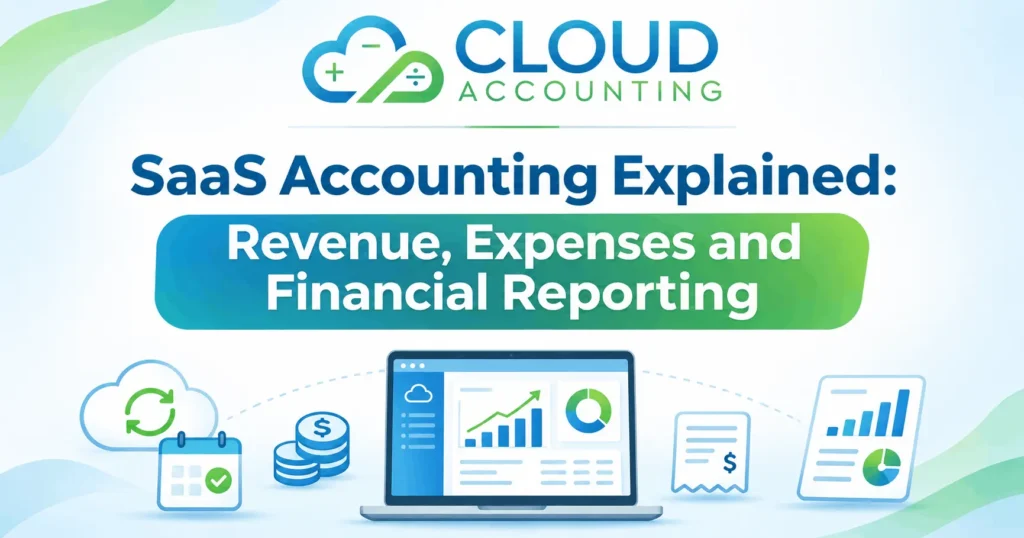
Running a Software as a Service (SaaS) business involves more than selling software subscriptions. You need to track recurring payments, recognise revenue correctly, manage operating expenses and understand how your business is performing financially.
Traditional accounting methods may not provide all the information a SaaS company needs. Subscription payments, annual contracts, customer cancellations and deferred revenue create accounting challenges that require careful management.
SaaS accounting helps software businesses record financial transactions accurately while tracking recurring revenue, customer costs, profitability and cash flow.
Whether you run a SaaS startup or manage an established subscription business, understanding SaaS accounting can help you make informed financial decisions and prepare for future growth.
This guide explains how SaaS accounting works, how to manage revenue and expenses, and which financial reports matter most.
What Is SaaS Accounting?
SaaS accounting is the process of recording, managing and reporting financial activities for businesses that provide software through subscriptions or other service arrangements.
Unlike businesses that mainly sell one-time products, SaaS companies often earn income over several months or years. Customers may pay monthly, annually or according to their software usage.
This creates an important difference between receiving money and earning revenue.
For example, a SaaS company might receive £12,000 from a customer for a 12-month subscription. Although the company receives the full payment upfront, it will generally recognise the subscription revenue over the period in which the software service is provided.
SaaS accounting helps businesses manage these differences while maintaining accurate financial statements.
It also supports important business activities, including:
- Tracking monthly and annual recurring revenue
- Recording customer subscription payments
- Managing deferred revenue
- Monitoring software development and operating costs
- Measuring customer acquisition expenses
- Preparing profit and loss statements
- Forecasting cash flow
- Producing financial reports for investors and management
With accurate financial records, SaaS businesses can better understand their financial position and identify opportunities for improvement.
Why SaaS Accounting Is Different From Traditional Accounting
The main difference between SaaS accounting and conventional product-based accounting is how revenue is generated and recognised.
A traditional retailer usually earns revenue when it transfers goods to customers. A SaaS company typically provides access to software continuously throughout a subscription period.
As a result, SaaS accounting must consider when services are delivered rather than relying only on payment dates.
1. Recurring Revenue
SaaS companies often generate revenue through regular subscription payments.
These payments may occur monthly, quarterly or annually.
Tracking recurring revenue helps businesses understand the value of their active subscriptions and estimate future income.
However, recurring revenue measures such as MRR and ARR are management metrics. They should not be confused with revenue recognised in the financial statements.
2. Deferred Revenue
Customers may pay for subscriptions before receiving the full service.
In these circumstances, amounts relating to services not yet delivered are generally recorded as deferred revenue, also called deferred income or a contract liability.
This prevents businesses from reporting future service income as revenue already earned.
3. Customer Retention and Churn
SaaS businesses depend on customers continuing their subscriptions.
When customers cancel or reduce their subscriptions, recurring revenue can fall.
Tracking customer churn helps businesses assess the strength of their subscription model and identify potential revenue risks.
4. Customer Acquisition Costs
SaaS companies often spend money on marketing, advertising, sales teams and commissions to attract customers.
These expenses can be significant, especially during early growth.
Understanding customer acquisition costs helps businesses evaluate whether their marketing and sales activities are financially sustainable.
5. Subscription Changes
Customers may upgrade, downgrade, cancel or renew subscriptions during their contracts.
These changes can affect billing, recurring revenue and the timing of revenue recognition.
Accurate SaaS accounting helps ensure these adjustments are recorded correctly.
SaaS Revenue Recognition Explained
Revenue recognition is one of the most important parts of SaaS accounting.
It determines when a company records income in its financial statements.
For companies reporting under International Financial Reporting Standards, IFRS 15 provides the main framework for recognising revenue from customer contracts. Businesses using US Generally Accepted Accounting Principles generally follow ASC 606.
These standards are broadly aligned, although specific requirements and interpretations may differ.
Under IFRS 15, businesses follow five steps:
- Identify the contract with the customer.
- Identify the goods or services promised in the contract.
- Determine the transaction price.
- Allocate the price to separate performance obligations.
- Recognise revenue when or as those obligations are satisfied.
For a standard SaaS subscription that provides continuous software access, revenue is generally recognised over the service period.
Example of SaaS Revenue Recognition
Suppose a customer purchases an annual software subscription for £2,400, paid upfront.
The subscription provides 12 months of continuous access, and the service begins on the first day of the accounting month.
Assuming the subscription is the only performance obligation and revenue is recognised evenly, the monthly amount would be:
£2,400 ÷ 12 months = £200 per month
The accounting treatment would look like this:
| Period | Revenue Recognised | Deferred Revenue Remaining |
|---|---|---|
| Payment received | £0 | £2,400 |
| End of Month 1 | £200 | £2,200 |
| End of Month 3 | £600 cumulative | £1,800 |
| End of Month 6 | £1,200 cumulative | £1,200 |
| End of Month 12 | £2,400 cumulative | £0 |
This approach ensures that financial statements reflect the service delivered during each accounting period.
The example assumes a straightforward fixed-price subscription. Contracts involving setup fees, usage charges, discounts or other services may require a different calculation.
For further information, businesses can refer to the IFRS 15 Revenue from Contracts with Customers standard.
Understanding Deferred Revenue in SaaS Accounting
Deferred revenue is particularly important for SaaS companies that collect annual subscription payments in advance.
When a customer pays before receiving the service, the company generally has an obligation to provide that service in the future.
The unearned amount is recorded as a liability rather than immediate revenue.
As the company provides the software service, the liability decreases and recognised revenue increases.
Why Deferred Revenue Matters
Accurate deferred revenue records help SaaS businesses:
- Avoid overstating revenue and profit
- Monitor outstanding service obligations
- Prepare more reliable financial statements
- Track income recognised in each accounting period
- Provide clearer information to investors
- Maintain consistency with the applicable accounting standards
Deferred revenue also provides information about services that customers have already paid for but have not yet received.
However, deferred revenue is not the same as available cash. The payment may already have been used to cover operating expenses.
Common Deferred Revenue Mistakes
One common mistake is recording an entire annual subscription payment as revenue on the payment date.
Other problems include recognising revenue twice, failing to adjust cancelled subscriptions and continuing to recognise revenue for services no longer being provided.
SaaS businesses should regularly reconcile subscription records with their accounting systems to identify these issues.
How to Manage SaaS Business Expenses
Revenue is only one side of SaaS accounting.
Businesses must also understand the costs involved in developing, operating and selling their software.
Accurate expense tracking helps SaaS companies measure profitability, manage budgets and make better investment decisions.
Software Development Costs
Developing a SaaS platform may involve significant expenditure.
Common costs include:
- Software developer salaries
- External development contractors
- Testing and quality assurance
- Product design
- Research activities
- Platform maintenance
- Security improvements
Not every software development cost receives the same accounting treatment.
Certain development expenditure may qualify for recognition as an intangible asset if the relevant accounting requirements are met. Other expenditure must be recorded as an expense when incurred.
The treatment depends on the reporting framework, the stage of development and the nature of the costs.
Businesses should therefore review development expenditure carefully rather than automatically treating every cost as an immediate expense or an asset.
Cloud Hosting and Infrastructure Costs
Most SaaS companies rely on cloud infrastructure to deliver their services.
These expenses may include server hosting, data storage, cloud platforms, security services and software monitoring.
Hosting costs may increase as customer numbers and platform usage grow.
Separating direct service delivery costs from general operating expenses helps businesses calculate gross profit more accurately.
Sales and Marketing Expenses
Marketing is essential for attracting new SaaS customers.
Typical expenses include digital advertising, content marketing, sales salaries, promotional campaigns and commissions.
A company should record these costs under suitable categories to understand how much it spends on acquiring customers.
Some incremental costs of obtaining customer contracts, such as qualifying sales commissions, may need to be capitalised and recognised over an appropriate period under the applicable accounting standards.
General advertising expenses are usually treated differently.
Employee and Administrative Expenses
SaaS businesses also need to manage everyday operating costs.
These may include:
- Employee salaries and benefits
- Office and remote working expenses
- Accounting and legal services
- Insurance
- Human resources expenses
- Administrative software subscriptions
- Professional training
Separating these costs into meaningful categories makes financial reporting more useful.
Important SaaS Financial Metrics to Track
Financial statements show a company’s accounting performance, but SaaS businesses also need operational measures to understand subscription growth and customer behaviour.
These measures help management assess revenue stability, customer retention and the financial efficiency of the business.
Monthly Recurring Revenue (MRR)
Monthly Recurring Revenue measures the normalised monthly value of recurring subscriptions.
For example, if a SaaS company has 150 customers paying £100 per month, its MRR is:
150 × £100 = £15,000
MRR helps management monitor the direction of recurring subscription income.
A company should use a consistent definition and exclude non-recurring charges, such as one-time implementation fees, unless its chosen reporting definition specifically provides otherwise.
Annual Recurring Revenue (ARR)
Annual Recurring Revenue estimates the annualised value of recurring subscriptions.
A common calculation is:
ARR = MRR × 12
If a SaaS company has £15,000 in MRR, its annualised recurring revenue would be £180,000.
ARR is useful for evaluating the scale of a subscription business.
However, ARR is not the same as actual annual revenue or a guaranteed forecast.
Customer Acquisition Cost (CAC)
Customer Acquisition Cost measures how much a company spends to acquire a new customer.
A basic formula is:
CAC = Sales and Marketing Acquisition Costs ÷ New Customers Acquired
Suppose a SaaS company spends £20,000 on customer acquisition activities and gains 100 new customers.
Its CAC would be £200 per customer.
Businesses should apply the same cost definitions across reporting periods to make comparisons meaningful.
Customer Lifetime Value (CLV)
Customer Lifetime Value estimates the economic value a customer generates during their relationship with the business.
One simple approach uses average revenue per customer, gross margin and expected customer lifetime.
For example:
CLV = Average Monthly Revenue per Customer × Gross Margin × Expected Customer Lifetime in Months
This is a simplified model. More detailed calculations may account for changing customer spending, retention patterns and the time value of money.
Comparing CLV with CAC helps businesses assess whether their customer acquisition strategy is sustainable.
Customer Churn Rate
Customer churn measures the percentage of customers lost over a period.
A basic formula is:
Customer Churn Rate = Customers Lost During the Period ÷ Customers at the Start of the Period × 100
If a company begins the month with 200 customers and loses 10, its customer churn rate is 5%.
This calculation excludes newly acquired customers from the starting customer base.
Businesses should also track revenue churn, because losing a large customer can have a greater financial impact than losing several small customers.
Gross Margin
Gross margin measures the proportion of recognised revenue remaining after deducting direct costs of delivering the service.
Gross Margin = (Revenue − Cost of Revenue) ÷ Revenue × 100
For example, if monthly recognised revenue is £50,000 and direct service delivery costs are £10,000, the gross margin is 80%.
This metric helps businesses understand the cost of operating their SaaS platform relative to the revenue it earns.
Financial Reporting for SaaS Businesses
Good financial reporting helps SaaS businesses move beyond basic bookkeeping.
Management needs clear information about profitability, cash flow, subscription performance and future financial requirements.
Several reports are particularly useful.
Profit and Loss Statement
The profit and loss statement, also called the income statement, shows revenue and expenses over a specific period.
For SaaS companies, it can help management evaluate:
- Recognised subscription revenue
- Other service income
- Direct service delivery costs
- Gross profit
- Sales and marketing expenditure
- Administrative expenses
- Operating profit or loss
Reviewing these figures monthly helps businesses identify cost increases and changes in profitability.
Balance Sheet
The balance sheet provides a snapshot of a company’s financial position at a particular date.
It includes assets, liabilities and equity.
For SaaS businesses, important balances may include cash, receivables, deferred revenue, accrued expenses and qualifying capitalised development costs.
Reviewing the balance sheet helps management understand financial obligations and the resources available to support operations.
Cash Flow Statement
Cash flow is especially important for SaaS companies that invest heavily in software development and customer acquisition.
A company may report accounting profit while experiencing cash shortages.
For example, subscription revenue may be recognised over time while customers pay at different stages of their contracts.
Cash flow reporting helps businesses monitor money moving into and out of the company.
It also supports decisions about hiring, marketing expenditure, technology investments and future funding requirements.
Monthly Management Accounts
Monthly management accounts bring together financial information to support business decisions.
They may include profit and loss results, balance sheet movements, cash flow analysis, budgets and key SaaS performance indicators.
For growing SaaS companies, monthly reporting can help identify financial problems before they become more serious.
Businesses that need regular financial information can explore Cloud Accounting’s Management Accounts services for support with financial reporting and performance monitoring.
How SaaS Accounting Supports Cash Flow Forecasting
SaaS businesses often benefit from predictable subscription income, but predictable billing does not always mean predictable cash flow.
Customer payment terms, cancellations, operating expenses and development investments can create pressure on available funds.
Cash flow forecasting helps management estimate future cash receipts and payments.
A useful SaaS cash flow forecast may include:
- Expected subscription collections
- New customer payments
- Annual renewals
- Expected cancellations and refunds
- Payroll expenditure
- Hosting and infrastructure costs
- Marketing budgets
- Software development spending
- Tax payments
- Loan repayments and financing commitments
Forecasts should reflect when cash is expected to move, rather than simply using recognised revenue figures.
For example, a customer may pay £12,000 in January for an annual subscription. That amount may appear in January’s cash receipts even though the business recognises the related subscription revenue throughout the year.
Understanding this difference helps management plan spending and avoid unexpected cash shortages.
Common SaaS Accounting Challenges
Even businesses with reliable subscription systems can experience accounting difficulties.
Recognising the most common problems is an important part of maintaining accurate records.
Incorrect Revenue Recognition
Recording subscription income when payment is received rather than when the service is delivered can lead to inaccurate financial statements.
Businesses should establish clear revenue recognition policies based on their contracts and accounting requirements.
Inaccurate Subscription Data
Subscription records may become inconsistent when customers upgrade, downgrade or cancel services.
These changes should be reflected accurately in billing records and accounting reports.
Poor Expense Classification
Combining software hosting costs, development expenses and marketing expenditure into broad categories can make profitability difficult to analyse.
A well-designed chart of accounts helps management understand where money is being spent.
Limited Financial Visibility
Some SaaS businesses focus heavily on new subscriptions without reviewing cash flow, gross margin or operating costs.
Revenue growth alone does not guarantee profitability.
Regular financial reporting provides a more complete picture of business performance.
Disconnected Financial Systems
SaaS businesses may use separate platforms for subscription billing, payment processing, customer management and accounting.
When these systems are not properly connected, financial data can become inconsistent.
Regular reconciliation and suitable integrations can help reduce these problems.
How Cloud Accounting Software Helps SaaS Businesses
Cloud accounting software gives SaaS businesses a central place to manage financial records and prepare reports.
Platforms such as Xero, QuickBooks Online and NetSuite can support different accounting needs depending on the size and complexity of the business.
With the right configuration and connected applications, cloud accounting can help businesses:
- Record subscription invoices and customer payments
- Track business expenditure
- Reconcile bank and payment processor transactions
- Manage accounts payable and receivable
- Produce financial statements
- Monitor financial performance
- Support multi-currency transactions where available
- Integrate billing and other business systems
However, cloud accounting software alone does not guarantee accurate SaaS revenue recognition.
Businesses may require additional subscription management tools, deferred revenue schedules or specialist accounting support.
Choosing suitable systems and establishing proper financial controls are both essential.
Best Practices for Accurate SaaS Accounting
SaaS businesses can improve their accounting processes by following a consistent approach.
Maintain accurate subscription records. Keep customer contracts, start dates, renewal dates, pricing changes and cancellation details up to date.
Apply consistent revenue recognition policies. Recognise subscription income according to the services delivered and the relevant accounting framework.
Reconcile financial data regularly. Compare billing platforms, payment processors, bank statements and accounting records.
Track expenses by category. Separate direct service costs from sales, marketing, development and administrative expenditure.
Review SaaS performance metrics. Monitor MRR, ARR, churn, CAC and gross margin using clearly defined calculations.
Prepare monthly financial reports. Review profitability, cash flow and financial obligations alongside operational measures.
Maintain financial controls. Establish suitable approval processes, access restrictions and supporting documentation for transactions.
Review accounting systems as the business grows. More complex subscription structures, international operations and multiple entities may require additional reporting capabilities.
These practices help SaaS businesses maintain more reliable financial information as their operations expand.
When Should a SaaS Business Hire a Specialist Accountant?
A growing SaaS business may reach a stage where basic bookkeeping is no longer sufficient.
Specialist accounting support can become valuable when a company starts offering complex subscription contracts, expanding internationally or preparing financial reports for investors.
Businesses may also need additional expertise when dealing with deferred revenue, development cost accounting, financial forecasting or multiple currencies.
An accountant who understands subscription businesses can help establish appropriate accounting policies, review financial records and prepare reports that management can use confidently.
Cloud Accounting provides SaaS Accounting Services to help businesses manage financial information and accounting processes.
Working with an experienced accounting team can also allow company leadership to devote more attention to product development, customers and commercial growth.
Conclusion
SaaS accounting plays an important role in managing the financial health of a subscription-based software business.
Unlike traditional businesses, SaaS companies must carefully manage recurring subscriptions, deferred revenue, development costs and customer-related expenses.
Accurate revenue recognition helps ensure that financial statements reflect the services delivered. Detailed expense tracking supports profitability analysis, while regular financial reporting provides insight into cash flow and business performance.
By combining reliable accounting records with SaaS metrics such as MRR, ARR, churn and customer acquisition costs, businesses can make more informed decisions.
As a SaaS company grows, maintaining accurate financial information becomes increasingly important for planning, investment and long-term success.
Get Expert SaaS Accounting Support
Managing subscription revenue, expenses and financial reporting can become more complex as your SaaS business expands.
At Cloud Accounting, we help businesses manage their accounting records, improve financial visibility and prepare meaningful financial reports.
Whether you need help with SaaS bookkeeping, revenue recognition, cloud accounting systems or management accounts, our team can discuss your requirements.
Book a discovery call with Cloud Accounting to discuss your SaaS accounting needs and find the right support for your business.