Businesses are changing how they manage accounts in 2025. What worked a few years ago is starting to feel outdated today. Many companies that once relied on desktop software are now looking for flexibility, real-time access, and better automation.
That is exactly why more businesses are making the move from Reckon to Cloud Accounting.
For years, Reckon helped small businesses handle bookkeeping, invoicing, and payroll. However, business needs have changed. Teams now work remotely. Owners want live financial data. Accountants expect faster collaboration. And businesses want systems that connect with ecommerce, payroll, CRM, and reporting tools without constant manual work.
This shift is pushing many companies toward cloud-based accounting platforms.
In this guide, we’ll explain why businesses are choosing Reckon to Cloud Accounting in 2025, what challenges they face with older systems, and what benefits they gain after switching.
Why Businesses Are Reconsidering Reckon in 2025
Many businesses did not plan to replace their accounting system this year. In fact, most started by trying to make their current setup work a little longer.
But eventually, the problems become harder to ignore.
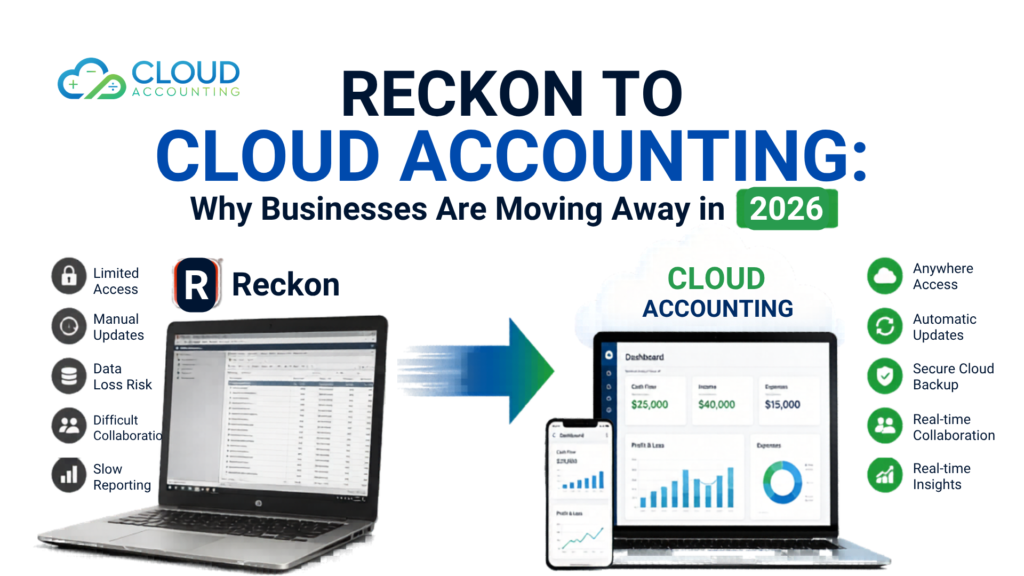
Desktop-based accounting systems often slow teams down. Access becomes limited. Manual backups create risk. Reporting takes longer. And when teams work from different locations, collaboration becomes difficult.
This is where many businesses begin to rethink their setup.
The move from Reckon to Cloud Accounting is often driven by daily frustrations, including:
- Limited remote access
- Manual software updates
- Difficulty sharing data with accountants
- Slow reporting processes
- Weak integration options
- Growing IT maintenance costs
At first, these issues may seem manageable. Over time, however, they affect productivity, visibility, and decision-making.
That is why more businesses are moving toward cloud accounting platforms that offer better flexibility and real-time access.
The Shift Toward Cloud Accounting Is Growing Fast
Cloud accounting is no longer seen as “new technology.” It has become the standard for modern businesses.
Business owners want systems they can access anywhere. Finance teams want live dashboards instead of waiting for reports. Accountants want direct collaboration without emailing backup files back and forth.
That demand is driving the growth of Reckon to Cloud Accounting migration projects worldwide.
In 2025, businesses are prioritising:
- Real-time financial visibility
- Remote access for teams
- Faster month-end reporting
- Automation for repetitive tasks
- Better integration with apps and banks
- Reduced dependency on local servers
Companies that delay these upgrades often find themselves spending more time fixing process problems instead of focusing on growth.
Remote Work Changed Accounting Expectations
A major reason behind the Reckon to Cloud Accounting trend is the way businesses operate today.
Teams no longer work only from one office.
Business owners travel. Accountants work remotely. Staff need access from different locations. Decision-makers expect financial information instantly.
Traditional desktop systems struggle in this environment.
Cloud accounting platforms solve this by allowing secure access from anywhere with an internet connection.
That means:
- Teams can collaborate in real time
- Business owners can review cash flow anytime
- Accountants can access live data instantly
- Reports update automatically
- Approvals happen faster
This flexibility has become a major advantage for growing businesses.
Businesses Want Better Integration With Modern Tools
Modern businesses use multiple systems every day.
They may use:
- Shopify
- Stripe
- PayPal
- CRM systems
- Inventory software
- Payroll platforms
- Ecommerce tools
The problem is that older accounting systems often struggle to connect smoothly with modern apps.
This creates manual work.
Teams end up:
- Exporting spreadsheets
- Re-entering transactions
- Fixing sync errors
- Updating reports manually
That wastes time and increases the risk of mistakes.
After moving from Reckon to Cloud Accounting, businesses often gain access to stronger integration ecosystems that connect financial data automatically across platforms.
That leads to:
- Faster reconciliation
- Better reporting accuracy
- Reduced manual entry
- More efficient workflows
Real-Time Reporting Is Becoming Essential
In the past, monthly reports were enough for many businesses.
That is no longer true.
Today, business owners want real-time visibility into:
- Cash flow
- Expenses
- Sales performance
- Profit margins
- Outstanding invoices
Waiting days or weeks for updated reports creates delays in decision-making.
This is another reason why businesses are choosing Reckon to Cloud Accounting migration in 2025.
Cloud platforms allow businesses to:
- Generate live reports instantly
- Monitor financial performance daily
- Access dashboards anytime
- Make faster business decisions
For growing companies, this visibility becomes extremely valuable.
Security and Backup Concerns Are Increasing
Many businesses underestimate the risk of relying on local desktop systems.
If a computer fails, files can become corrupted or lost. Manual backups may not happen consistently. Hardware issues can interrupt operations.
Business owners are becoming more aware of these risks.
Cloud accounting platforms typically provide:
- Automatic backups
- Secure cloud storage
- User access controls
- Multi-factor authentication
- Reduced hardware dependency
This added protection is another major factor driving Reckon to Cloud Accounting migration projects.
Businesses Want to Reduce Manual Work
One of the biggest complaints businesses have with older accounting systems is repetitive manual tasks.
Teams often spend hours:
- Entering transactions
- Matching bank feeds
- Updating spreadsheets
- Chasing approvals
- Preparing reports manually
This creates inefficiency.
Cloud accounting systems help automate many of these processes.
Automation features can include:
- Bank feed syncing
- Automated invoice reminders
- Rule-based transaction coding
- Real-time reconciliations
- Scheduled reporting
As businesses grow, reducing manual work becomes critical.
Accountants Are Encouraging Cloud Migration
In many cases, accountants themselves are encouraging clients to move from Reckon to Cloud Accounting.
Why?
Because cloud systems improve collaboration significantly.
Instead of:
- Sending backup files
- Waiting for file versions
- Working on outdated data
Accountants can work directly inside live systems.
This improves:
- Communication
- Accuracy
- Advisory services
- Reporting speed
It also helps accountants provide faster support during tax periods, audits, and financial reviews.
Growing Businesses Need Scalability
A system that works for a small business may not support long-term growth.
As businesses expand, they often need:
- More users
- Better reporting
- Multi-location support
- Ecommerce integration
- Advanced automation
- Department tracking
This is where many companies begin exploring Reckon to Cloud Accounting migration options.
Cloud platforms are generally built to scale more easily as business operations become more complex.
That gives businesses more flexibility for future growth.
Common Challenges During Reckon to Cloud Accounting Migration
Although the benefits are clear, migration still requires planning.
Businesses often face challenges such as:
- Cleaning old financial data
- Mapping chart of accounts
- Handling payroll history
- Migrating customer and supplier records
- Matching opening balances
- Training staff on new systems
Without proper planning, mistakes can happen.
That is why many businesses work with migration specialists during the transition process.
A proper migration plan helps reduce:
- Data errors
- Downtime
- Reporting issues
- Reconciliation problems
How Cloud Accounting Helps Businesses Operate Better
Once businesses complete the migration, the difference often becomes noticeable quickly.
Many businesses report improvements such as:
- Faster reporting
- Better collaboration
- Reduced admin work
- Easier accountant access
- More accurate financial visibility
- Improved workflow efficiency
The move from Reckon to Cloud Accounting is not just a software upgrade.
It changes how businesses manage operations, make decisions, and support growth.
Choosing the Right Cloud Accounting Platform
Not every cloud accounting system fits every business.
Some businesses need:
- Simple bookkeeping
- Strong inventory management
- Advanced reporting
- Multi-currency support
- Payroll integration
- Ecommerce connectivity
The right platform depends on:
- Business size
- Industry
- Reporting needs
- Team structure
- Growth plans
This is why businesses should assess their requirements carefully before migrating.
Why Many Businesses Are Making the Move in 2025
The accounting software market is changing quickly.
Businesses now expect:
- Accessibility
- Automation
- Flexibility
- Integration
- Real-time insights
Older desktop systems often struggle to meet these expectations.
That is why Reckon to Cloud Accounting migration continues to grow in 2025.
Businesses are not switching simply because cloud accounting is popular.
They are switching because operational needs have changed.
How Cloud Accounting Can Help
At Cloud Accounting, we help businesses plan and manage successful Reckon to Cloud Accounting migration projects.
We help with:
- Data review and cleanup
- Migration planning
- Historical data transfer
- System setup
- Reconciliation checks
- Staff support and guidance
Our goal is to help businesses move confidently while keeping financial data accurate and organised.
Final Thoughts
Many businesses stayed with desktop accounting systems for years because they felt familiar.
But business operations have changed.
Remote work, automation, real-time reporting, and system integration are now essential for modern businesses.
That is why more companies are moving from Reckon to Cloud Accounting in 2025.
The move is not just about replacing software.
It is about building a more flexible, connected, and scalable financial system for the future.
If your current setup is slowing your business down, now may be the right time to explore your cloud accounting options.