But once firms go through a Professional Services NetSuite Migration, they quickly realise something bigger is happening. At the start, teams focus on data, system setup, and making sure everything transfers correctly. However, once the system goes live, the real shift begins. It becomes clear that this is not just a software change. It directly impacts how the business runs every day.
It’s not just the software that changes. The business changes how it operates, how workflows run, and how teams work across departments. Tasks that once took hours now take minutes. Processes that allowed flexibility now demand structure and consistency. Teams stop relying on instinct or delayed reports and start using real-time data to make decisions. This shift affects every part of the organisation, from project delivery to financial control.
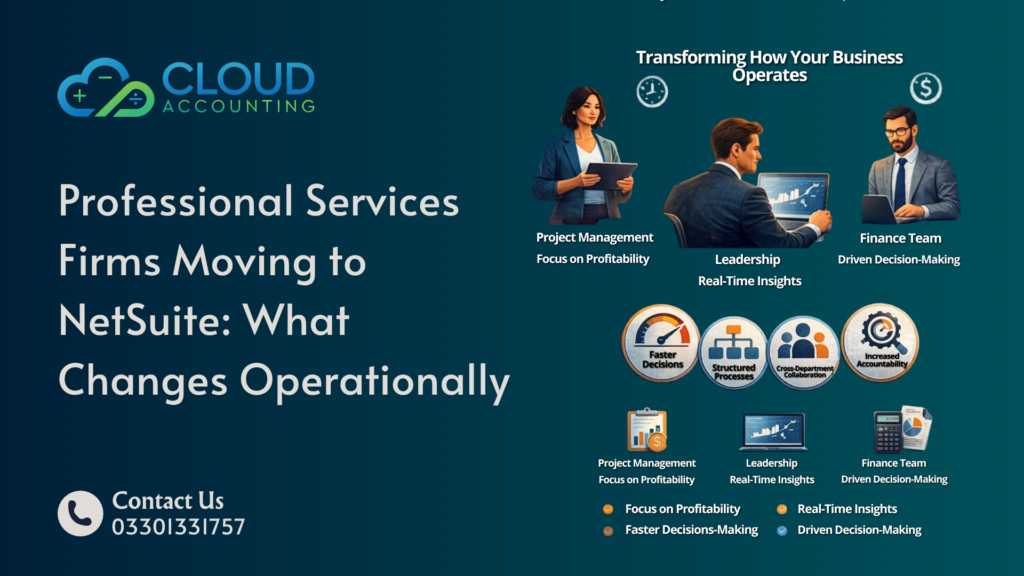
Project managers stop focusing only on deadlines and start tracking profitability and margins. Finance teams move beyond reporting past results and begin guiding decisions in real time. Leadership no longer waits for updates and expects accurate insights immediately. Even small habits change. Teams enter timesheets on time, maintain clean data from the start, and follow defined workflows without delay. There is little room left to fix issues later because everything stays connected and visible.
And here’s the reality. Most firms prepare for the technical side of Professional Services NetSuite Migration. They plan the data transfer, configure the system, and set timelines. But very few prepare for the operational shift that follows. They overlook how teams will adapt to stricter processes, how accountability will increase, how faster decision-making will affect leadership, and how greater visibility will expose hidden inefficiencies.
This is where the real challenge begins. A Professional Services NetSuite Migration does not just upgrade a system. It resets how the business operates. Firms that understand this early manage the transition better, support their teams effectively, and gain real value from the system. Those that don’t struggle, not because the software fails, but because the business was not ready for the level of change it brings.
Why Firms Reach the Breaking Point Before Migration
Before starting a Professional Services NetSuite Migration, most firms face growing pressure.
At first, the issues seem small.
Then they stack up:
- Disconnected systems
- Delayed reporting
- Manual work slowing teams down
- Limited visibility into performance
At this point, a Professional Services NetSuite Migration stops being optional.
It becomes necessary.
What NetSuite Actually Changes
A Professional Services NetSuite Migration is not just replacing software.
It connects:
- Finance
- Projects
- Billing
- Resources
- Reporting
Because of this, a Professional Services NetSuite Migration changes how everything works together.
Real-Time Visibility Changes Everything
One of the biggest outcomes of a Professional Services NetSuite Migration is real-time visibility.
Before:
- Reports are delayed
- Data is incomplete
After a Professional Services NetSuite Migration:
- Dashboards update instantly
- Project data is always live
- Financial reports are accurate
This changes how leaders operate.
Accountability Becomes Non-Negotiable
With a Professional Services NetSuite Migration, transparency increases.
Now:
- Time tracking is visible
- Project margins are clear
- Resource usage is tracked
This level of visibility forces accountability after a Professional Services NetSuite Migration.
Teams can no longer rely on delayed updates or manual fixes.
Project and Finance Teams Align
A key shift during Professional Services NetSuite Migration is the alignment between projects and finance.
Previously:
- Project teams focus on delivery
- Finance teams focus on numbers
After a Professional Services NetSuite Migration:
- Projects link directly to financial performance
- Budgets update in real time
- Revenue aligns with project progress
This changes how decisions are made.
Billing Becomes Faster and More Controlled
Billing improves significantly after a Professional Services NetSuite Migration.
Before:
- Delays are common
- Errors happen often
After:
- Time flows into billing automatically
- Invoices are generated quickly
However, a Professional Services NetSuite Migration also introduces stricter control.
Data must be accurate. Processes must be followed.
Resource Management Becomes Data-Driven
A Professional Services NetSuite Migration transforms resource planning.
Firms can now:
- Track utilisation
- Forecast demand
- Allocate resources better
But with a Professional Services NetSuite Migration, inefficiencies become visible.
This forces firms to improve planning.
Processes Become Standardised
Another key change in Professional Services NetSuite Migration is process standardisation.
Before:
- Informal workflows
- Team-specific processes
After:
- Defined workflows
- Structured approvals
A Professional Services NetSuite Migration replaces guesswork with consistency.
Decision-Making Speeds Up
With a Professional Services NetSuite Migration, decision-making becomes much faster and more direct. Instead of waiting days or even weeks for reports, leaders now have access to real-time data at any moment. This means they can respond quickly to issues, adjust strategies on the go, and make informed choices based on current performance rather than outdated information.
However, this speed comes with responsibility. A Professional Services NetSuite Migration only delivers accurate insights if the system is set up correctly and the data entered is reliable. If the data is incomplete or incorrect, decisions can go wrong just as quickly as they are made. In other words, faster access to information improves decision-making only when the foundation is strong.
Collaboration Across Teams Improves
A Professional Services NetSuite Migration also changes how teams work together. Instead of operating in separate systems, departments become connected through one shared platform. Sales feeds directly into projects, projects link into finance, and finance drives reporting across the business. This creates a more connected and transparent way of working.
As a result, collaboration improves naturally. Teams have access to the same information, reducing confusion and miscommunication. However, this also means teams become more dependent on each other. If one department fails to update data or follow processes, it can affect the entire system. After a Professional Services NetSuite Migration, success depends on consistent input and shared responsibility across all teams.
The Biggest Challenge: People and Change
Every Professional Services NetSuite Migration involves change. Not just systems, but people. And this is where most firms underestimate the real challenge. Technology can be configured and tested, but people need time to adapt. Teams must adjust how they work, how they enter data, and how they follow structured processes on a daily basis.
For many employees, this shift can feel uncomfortable at first. Tasks that were once flexible now require consistency. Data that could be entered later must now be recorded accurately and on time. Workflows that varied between teams are now standardised across the business. These changes may seem small, but together they create a completely new way of operating.
Without proper support, this transition becomes difficult. Teams may resist new processes, delay adoption, or fall back into old habits. As a result, even a well-executed Professional Services NetSuite Migration can fail to deliver its full value. That’s why training, clear communication, and ongoing support are essential. When people understand the purpose behind the change and feel confident using the system, the migration becomes a success not just technically, but operationally.
Common Mistakes During Migration
Many firms struggle with Professional Services NetSuite Migration, not because the system is difficult, but because of avoidable mistakes made during the process. One of the most common issues is treating the migration as purely a technical project. In reality, it affects the entire business, not just the IT team. When firms ignore this, they miss the operational impact that follows.
Another major problem is migrating poor-quality data. If your existing data is incomplete, inconsistent, or messy, those issues don’t disappear after migration. They carry over and become harder to fix later. Skipping proper training is another mistake that slows everything down. Teams may have access to a powerful system, but without understanding how to use it correctly, adoption suffers.
Firms also often ignore process redesign. Instead of improving workflows, they simply move old habits into a new system, which limits the benefits of the migration. Each of these mistakes reduces the overall value of a Professional Services NetSuite Migration, turning what should be a business upgrade into a missed opportunity.
What Successful Firms Do Differently
Successful Professional Services NetSuite Migration projects don’t happen by luck. They follow a clear, structured approach from the very beginning. Instead of rushing into the system, these firms take time to prepare properly. They clean and organise their data before migration, making sure errors are not carried into the new system. They also rethink how their workflows should work, rather than simply copying old processes that may already be inefficient.
Another key difference is how they handle people. Successful firms train their teams early, not just on how to use NetSuite, but on why processes are changing. This helps reduce resistance and improves adoption across departments. They also focus heavily on making sure the system is actually used correctly after go live, rather than assuming everything will fall into place automatically.
In simple terms, a successful Professional Services NetSuite Migration is never rushed. It is planned carefully, executed with attention to detail, and supported after implementation. That’s what turns a migration into a real business improvement, not just a system switch.
How Cloud Accounting Supports Your Migration
At Cloud Accounting, we specialise in Professional Services NetSuite Migration.
We don’t just move data.
We help firms adapt operationally.
Our Approach
1. Planning
We assess your systems before starting your Professional Services NetSuite Migration.
2. Data Preparation
We clean and structure your data for accuracy.
3. Process Alignment
We redesign workflows to match your goals.
4. Migration Execution
We handle your Professional Services NetSuite Migration with precision.
5. Ongoing Support
We ensure your system works after go-live.
Final Thoughts
A Professional Services NetSuite Migration is more than a system change. It reshapes how your business operates on a daily level. Once in place, it brings greater visibility into performance, stronger accountability across teams, and faster, more informed decision-making. You’re no longer working with delayed data or disconnected systems. Everything becomes clearer, more connected, and easier to manage.
However, these benefits don’t come automatically. A Professional Services NetSuite Migration also demands better processes, stronger discipline, and careful planning from the start. Teams need to adapt, data needs to be accurate, and workflows must be structured to support the system.
When done right, a Professional Services NetSuite Migration does more than solve current problems. It builds a stronger foundation for growth, giving your firm the control and clarity needed to scale with confidence.
Ready to Get Started?
If you’re planning a Professional Services NetSuite Migration, this is not something to leave to chance. The difference between a smooth transition and a messy one often comes down to planning and expertise.
Work with a team that understands both the technical setup and the operational impact behind the scenes. That’s what ensures your migration actually improves how your business runs, not just where your data sits.
Talk to Cloud Accounting today and take the first step toward a NetSuite migration that works the way your business needs it to.