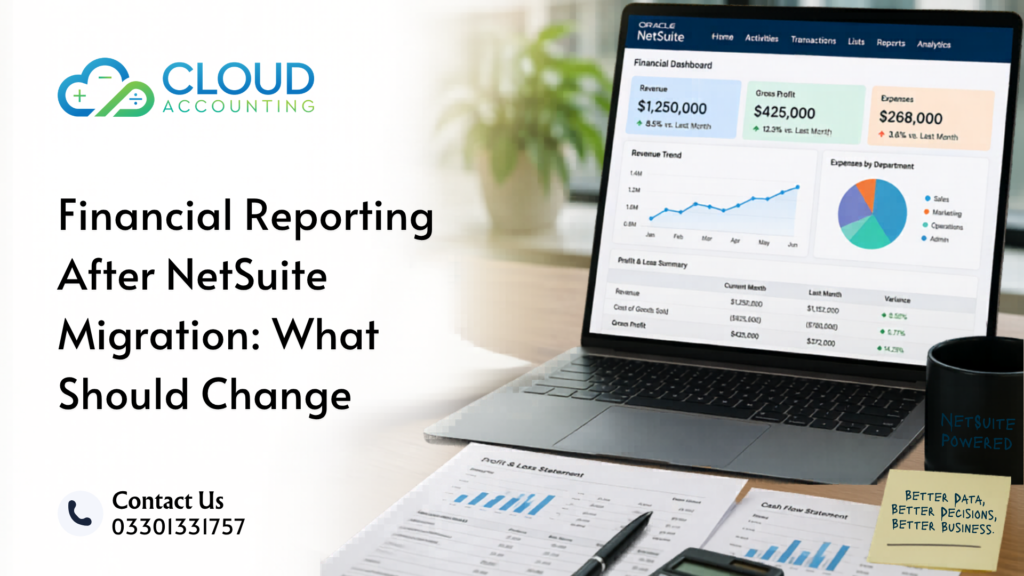
You’ve completed your NetSuite migration. Data is in, the system is live, and your teams have started using it. On the surface, it feels like a major step forward. So naturally, you expect everything to improve straight away. But that’s not always how it works.
Here’s something most businesses don’t expect. If your reports still look and behave the same as before, then your migration has only done half the job. That’s because migration is just the starting point. It moves your data into a new system, but it doesn’t automatically improve how you use that data or how you make decisions from it.
In many cases, businesses fall into the same routine they had before. They log into NetSuite, run the same types of reports, export data into spreadsheets, and continue working in familiar ways. Nothing feels broken, but nothing feels significantly better either. This is where the real problem starts to show.
You now have a powerful ERP system, but your reporting mindset hasn’t changed. And without that shift, the system cannot deliver its full value.
That’s where NetSuite Financial Reporting becomes important. It’s not just about generating reports faster. It’s about changing how your business understands, uses, and acts on financial data every day.
In simple terms, reporting should no longer be a routine task that happens at the end of the month. It should become a daily tool that helps you run the business more effectively.
This shift has a direct impact. Better reporting leads to faster decisions, stronger financial control, clearer visibility across teams, and more confident planning. Without it, even a system like NetSuite can feel underused.
So the real question is not whether your migration was successful. The real question is whether your financial reporting has actually evolved with it.
If your NetSuite reports still feel slow or unclear, it’s not the system holding you back. It’s how it’s being used. Let’s fix that before it starts costing you real decisions.
Why Financial Reporting Needs to Change After Migration
A common mistake is carrying old habits into a new system.
You migrate from spreadsheets or legacy software. Then you recreate the same reports inside NetSuite.
On the surface, it works.
But underneath, you are missing the real value.
Older systems were built for:
- Static reports
- Manual updates
- Delayed insights
NetSuite is built for:
- Real-time visibility
- Connected data
- Automated reporting
So if your reporting approach stays the same, your results will too.
That’s why NetSuite Financial Reporting should not be treated as a simple upgrade. It should be treated as a complete shift in how reporting works.
From Static Reports to Real-Time Insights
Let’s start with the biggest change.
Before migration, many businesses rely on:
- Monthly reports
- Excel exports
- End-of-period analysis
That means decisions are based on old data.
After migration, NetSuite Financial Reporting gives you live financial visibility.
You can see:
- Revenue as it happens
- Expenses as they are recorded
- Cash position in real time
This changes how decisions are made.
Instead of reacting after the fact, you can act while things are happening.
And once you experience real-time reporting, going back to delayed reports feels like guessing instead of knowing.
Better Data Accuracy and Consistency
Here’s a problem most finance teams know too well.
Different reports showing different numbers.
It leads to confusion, wasted time, and lack of trust in data.
This usually happens because:
- Data is spread across systems
- Manual adjustments create errors
- Reports are built separately
With NetSuite Financial Reporting, everything comes from a single system.
So what changes?
- One consistent data source
- Fewer errors and mismatches
- Clear audit trails
As a result, teams spend less time fixing numbers and more time analysing them.
Custom Dashboards That Actually Help You Decide
Old systems make you search for information.
NetSuite brings information to you.
Instead of digging through reports, you can build dashboards that show exactly what matters.
For example:
- A CFO sees profit, cash flow, and forecasts
- A sales manager tracks revenue performance
- An operations team monitors costs
This is where NetSuite Financial Reporting becomes practical.
Because now:
- You don’t waste time searching
- You focus on decisions instead
And that shift alone can save hours every week.
Faster Month-End Close (And Less Stress)
Let’s talk about month-end.
For many businesses, it’s still a painful process:
- Manual reconciliations
- Late adjustments
- Long working hours
After migration, this should change.
With NetSuite Financial Reporting, you can:
- Automate recurring entries
- Reduce manual reconciliation
- Track close progress in real time
Many businesses reduce closing time from weeks to just a few days.
Some even move towards continuous closing.
If your team is still struggling at month-end, it’s a sign your system is not being used fully.
Moving Beyond Basic Financial Reports
Most businesses stop at:
- Profit and Loss
- Balance Sheet
- Cash Flow
These are important.
But they only tell part of the story.
With NetSuite Financial Reporting, you can go deeper.
You can analyse:
- Profit by department
- Performance by product or service
- Customer-level profitability
- Budget vs actual results
This gives you insight into what is working and what is not.
And that’s where real growth decisions come from.
Supporting Multi-Entity and Global Reporting
If your business operates across multiple entities, things can become complex very quickly. You are not just managing one set of books. You are dealing with different currencies, tax rules, compliance requirements, and reporting standards all at once. Even small differences between entities can create confusion when it comes to consolidation.
Without the right system, this usually leads to slow and messy processes. Finance teams spend hours pulling data from different sources, adjusting numbers, and trying to align reports manually. By the time everything is ready, the information is already outdated.
This is where NetSuite Financial Reporting makes a real difference after migration.
Instead of managing each entity separately, NetSuite allows you to handle everything within one connected system. Financial data flows through a single structure, which removes the need for constant manual adjustments. Currency conversions can be handled automatically, reducing errors and saving time. Consolidated reports can be generated without rebuilding data from scratch each time.
As a result, reporting becomes faster and more reliable. You can see group-level performance without delays. You get clear visibility across all entities, not just individual ones. And most importantly, your team spends less time fixing data and more time understanding it.
For growing businesses, especially those expanding into new regions, this is not just a helpful feature. It becomes essential.
Common Mistakes After NetSuite Migration
Even after switching to NetSuite, many businesses limit its potential.
Here are the most common mistakes.
1. Rebuilding old reports without improving them
You are repeating the past instead of moving forward.
2. Ignoring dashboards
Reports are useful. Dashboards give faster insights.
3. Overcomplicating reporting structures
More complexity does not mean better reporting.
4. Poor data setup at the start
If your data structure is weak, your reports will be too.
5. Lack of training for teams
If people don’t understand the system, they won’t use it properly.
Avoiding these mistakes can make a huge difference.
How to Get the Most Out of NetSuite Financial Reporting
If you want to see real improvement, focus on these steps.
Set clear reporting goals
Decide what insights your business actually needs.
Use role-based dashboards
Different teams need different views.
Automate wherever possible
Reduce manual work and errors.
Keep your data clean
Good reporting starts with clean data.
Review and improve regularly
Reporting should evolve as your business grows.
Most importantly, treat reporting as a decision-making tool, not just a finance task.
What Success Looks Like After Migration
So what should success look like?
After using NetSuite Financial Reporting properly, you should see:
- Faster access to financial data
- More accurate and consistent reports
- Shorter month-end close cycles
- Better visibility across the business
- More confident decision-making
If you are not seeing these changes, your reporting setup needs attention.
Final Thoughts
A NetSuite migration is not just about changing software. It’s about changing how your business operates on a daily level. The system gives you the tools, but the real value comes from how you use them.
At the centre of this shift is NetSuite Financial Reporting. When used properly, it turns raw data into clear, useful insights that teams can act on straight away. It helps reduce delays, improves accuracy, and gives decision-makers the confidence to move faster.
Over time, this creates a ripple effect across the business. Finance teams spend less time fixing numbers and more time analysing them. Leadership gets timely updates instead of waiting for reports. Teams start relying on data instead of guesswork.
However, this only happens if your reporting approach evolves with the system.
If you are still relying on old report formats, manual processes, or delayed insights, then you are only using a fraction of what NetSuite can offer. The system is capable of much more, but it requires a shift in mindset as well as setup.
In simple terms, NetSuite gives you the ability to see your business clearly. The question is whether you are ready to use that visibility to its full potential.
CTA: Turn Your NetSuite Reports Into Real Business Insights
If your reports still feel slow, unclear, or limited, it’s time to fix that.
We help businesses:
- Improve NetSuite Financial Reporting setups
- Build custom dashboards that matter
- Clean and structure financial data properly
- Unlock real-time reporting capabilities
Get in touch today and start using your NetSuite data to make smarter, faster business decisions.