Small business software works well… until it doesn’t.
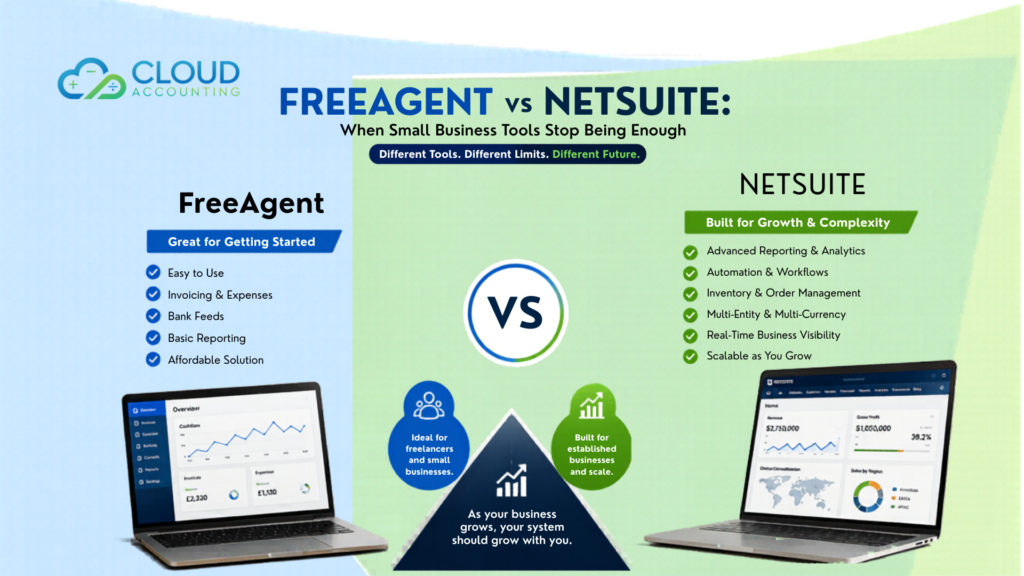
At the start, most businesses want something simple. They need invoicing, expense tracking, bank feeds, and basic reports. That’s exactly why many companies choose FreeAgent.
It’s easy to use. It’s affordable. And for freelancers or very small teams, it does the job.
But growth changes everything.
More customers. More transactions. More staff. More reporting needs. Suddenly, the same system that once felt “simple” starts creating delays, manual work, and reporting problems.
That’s where the FreeAgent vs NetSuite conversation begins.
This is not about saying one platform is good and the other is bad. They were built for different stages of business. The real question is whether your current software still fits where your company is heading.
Let’s look at where FreeAgent works well, where it starts falling behind, and why growing businesses eventually move toward NetSuite.
Why Small Businesses Choose FreeAgent
Most businesses don’t start with enterprise software.
They start with tools that are:
- Easy to learn
- Affordable
- Quick to set up
- Designed for basic accounting
FreeAgent became popular because it solves common small business problems without complexity.
Business owners can:
- Create invoices
- Track expenses
- Connect bank accounts
- Handle basic VAT tasks
- Run simple financial reports
For freelancers, consultants, contractors, and small service businesses, this is often enough in the early stages.
The platform removes confusion and helps business owners stay organised without needing a full finance department.
That simplicity is FreeAgent’s biggest strength.
However, it can also become its biggest limitation later.
The Problem Starts When the Business Grows
Growth sounds exciting. But operationally, growth creates pressure.
More sales create more accounting activity.
More staff create more approvals and reporting needs.
More locations create more complexity.
This is where businesses begin to notice cracks in smaller accounting systems.
The FreeAgent vs NetSuite comparison becomes important when companies start asking questions like:
- Why are reports taking so long?
- Why are we still using spreadsheets everywhere?
- Why can’t departments see the same data?
- Why are finance tasks becoming manual again?
- Why is forecasting so difficult?
These problems rarely appear overnight.
They build slowly as the business scales.
At first, teams work around the limitations. Then those workarounds become daily frustrations.
Eventually, businesses realise the issue is not the people. It’s the system.
FreeAgent Was Built for Simplicity
FreeAgent was designed for small business owners who want straightforward accounting.
And to be fair, it succeeds at that.
The platform keeps things simple on purpose.
That works well when:
- The business has a small transaction volume
- Reporting needs are basic
- There are few users
- Operations are uncomplicated
However, growing companies usually need:
- Deeper reporting
- Multi-department visibility
- Advanced workflows
- Automation
- Inventory management
- Consolidated financials
- Forecasting tools
- Custom approvals
This is where FreeAgent starts reaching its limits.
The system was never built to manage large operational complexity.
That does not make it a bad platform.
It simply means the business has outgrown the tool.
NetSuite Was Built for Growing Companies
Now let’s look at the other side of the FreeAgent vs NetSuite discussion.
NetSuite was designed very differently.
Instead of focusing only on small business accounting, NetSuite was built as a full ERP system.
ERP stands for Enterprise Resource Planning.
That means the platform connects multiple business functions into one system.
Instead of separate disconnected tools, businesses can manage:
- Accounting
- Inventory
- Purchasing
- CRM
- Reporting
- Forecasting
- Order management
- Multi-entity operations
from one platform.
This changes how businesses operate.
Instead of departments working separately, everyone works from shared real-time data.
That visibility becomes extremely valuable as businesses grow.
Reporting Is Usually the First Major Breaking Point
One of the biggest triggers behind FreeAgent vs NetSuite migration decisions is reporting frustration.
At first, simple reports are enough.
But growing businesses eventually need answers like:
- Which products are most profitable?
- Which department spends the most?
- Which customers generate the highest margins?
- What does cash flow look like next quarter?
- Which locations are underperforming?
Small business systems often struggle here.
Teams start exporting data into spreadsheets because the built-in reports cannot answer deeper business questions.
That creates:
- Delayed reporting
- Human errors
- Duplicate work
- Conflicting numbers
- Decision-making delays
NetSuite approaches reporting differently.
Instead of basic accounting summaries, businesses gain access to:
- Real-time dashboards
- Custom reports
- Department-level analysis
- Forecasting tools
- Consolidated reporting
- KPI tracking
This gives leadership faster visibility into what is actually happening inside the business.
Manual Processes Start Taking Over
Another major issue in the FreeAgent vs NetSuite discussion is operational efficiency.
Many businesses assume accounting software should reduce manual work.
But smaller systems can actually increase manual work once complexity grows.
Teams often end up:
- Copying data between systems
- Updating spreadsheets manually
- Chasing approvals through emails
- Re-entering invoices
- Reconciling information from different platforms
These tasks waste time.
More importantly, they increase the risk of mistakes.
NetSuite focuses heavily on automation and workflow control.
Businesses can automate:
- Invoice approvals
- Purchase workflows
- Reporting schedules
- Revenue recognition
- Inventory tracking
- Financial consolidations
That reduces operational bottlenecks and improves consistency.
Inventory Management Changes Everything
Inventory is another major reason businesses move beyond smaller accounting systems.
FreeAgent works well for service-based businesses with simple needs.
But inventory-heavy companies often require much deeper functionality.
Once inventory becomes more advanced, businesses may need:
- Multi-location stock tracking
- Purchase order management
- Serial number tracking
- Warehouse visibility
- Automated stock updates
- Demand forecasting
Trying to manage this manually creates serious problems.
Inventory errors affect:
- Financial reporting
- Customer orders
- Purchasing decisions
- Cash flow
NetSuite was built with inventory operations in mind.
That gives growing product-based businesses more control as operations become larger and more complicated.
Multi-Entity Businesses Need Better Visibility
At first, businesses usually operate as one company.
Then growth happens.
New brands appear. New subsidiaries open. International expansion begins.
Suddenly, finance becomes far more complicated.
Businesses may need:
- Multi-currency support
- Consolidated reporting
- Intercompany accounting
- Regional tax management
- Separate entity visibility
This is where small business accounting software often struggles.
NetSuite was designed for these scenarios.
That makes it much easier for leadership teams to manage complex operations without relying on disconnected systems.
Finance Teams Start Working Differently
One thing businesses rarely expect during FreeAgent vs NetSuite migration discussions is how much finance roles change afterward.
With smaller systems, finance teams spend most of their time:
- Fixing errors
- Updating spreadsheets
- Chasing missing information
- Building reports manually
That leaves little time for analysis or strategic planning.
After moving to ERP systems like NetSuite, finance teams can focus more on:
- Forecasting
- Business planning
- Profitability analysis
- Performance insights
- Growth support
This changes finance from a reporting function into a decision-support function.
That shift becomes extremely valuable as companies scale.
The Cost Question Matters Too
Many businesses delay ERP migration because they worry about cost.
And honestly, NetSuite is more expensive than FreeAgent.
There’s no point pretending otherwise.
But the real question is not:
“How much does the software cost?”
The better question is:
“How much operational inefficiency is already costing the business?”
Manual work, reporting delays, inventory errors, and disconnected systems all create hidden costs.
Sometimes businesses spend more money fixing limitations than they would upgrading properly.
That’s why many growing businesses eventually decide the investment makes financial sense.
Migration Requires Proper Planning
Moving from FreeAgent to NetSuite is not a simple software switch.
It’s a business transition.
That means migration planning matters heavily.
Businesses need to review:
- Historical data quality
- Reporting structures
- Workflows
- User permissions
- Inventory setup
- Integrations
- Financial processes
Poor planning can create major issues later.
That’s why experienced migration support becomes important.
A good migration partner helps businesses:
- Clean data before migration
- Reduce errors
- Map systems correctly
- Protect financial accuracy
- Minimise operational disruption
Without proper preparation, businesses risk carrying old problems into the new system.
When Is It Time to Move Beyond FreeAgent?
Not every company needs NetSuite.
Some businesses can stay on FreeAgent successfully for years.
However, warning signs usually appear when:
- Reporting becomes difficult
- Teams rely heavily on spreadsheets
- Manual work increases
- Inventory becomes harder to manage
- Multiple systems stop syncing properly
- Financial visibility becomes delayed
- Growth creates operational confusion
These are signs the business may be outgrowing small business software.
The goal is not to switch platforms too early.
But waiting too long can also create operational strain.
How Cloud Accounting Helps Businesses Migrate
Choosing a new system is only one part of the process.
The bigger challenge is moving correctly.
At Cloud Accounting, we help businesses plan and manage accounting software migrations carefully and accurately.
We help with:
- Data migration planning
- Financial data cleanup
- System mapping
- Reporting setup
- ERP transition support
- Post-migration reviews
Most importantly, we help businesses avoid the common mistakes that create reporting and operational problems later.
Every business grows differently.
That’s why every migration strategy should fit the business, not just the software.
Final Thoughts on FreeAgent vs NetSuite
The FreeAgent vs NetSuite conversation is really about business growth.
FreeAgent works extremely well for smaller businesses that want simplicity and easy accounting management.
But as operations grow, complexity grows with them.
At some point, businesses need more visibility, more automation, and stronger operational control.
That’s where NetSuite becomes valuable.
The right platform depends on:
- Business size
- Operational complexity
- Reporting needs
- Growth plans
- Inventory requirements
- Team structure
The important thing is recognising when your current system is starting to hold the business back.
Because software should support growth, not slow it down.
If your business is starting to outgrow small business accounting tools, Cloud Accounting can help you assess your next step and plan a safer migration strategy.